
11-24-2012, 10:52 PM
|
 |
Ultimate Warrior
|
|
Join Date: Jan 2002
Location: Northern Virginia
Posts: 8,430
|
|

Quote:
Originally Posted by Tom Vaught

the National Advisory Committee for Aeronautics, in studies aimed at increasing the power from aircraft piston engines, came to the following conclusion: “The data indicated that water was a very effective internal coolant, permitting large increases in engine power as limited by either knock or by cylinder temperatures.”
Engine power production, referred to as brake mean effective pressure (BMEP), is measured by taking the average effective pressure of the cylinders as they progress through intake, compression, ignition, and exhaust strokes. Added power comes as a result of greater pressure, but a higher temperature inside the cylinder accompanies greater pressure. These higher temperatures can lead to detonation, referred to as engine knock, or pre-ignition, both of which are cases where the fuel-air mixture burns in an undesirable manner and can be destructive to an engine. To combat knock and pre-ignition as power increases, a richer air-to-fuel ratio is normally required. If the addition of extra fuel doesn’t provide enough knock protection, then a higher-octane fuel, which is more resistant to knock and pre-ignition, may be used. However, once the knock limit of a higher-octane fuel is reached, can anything be done? This is where a water injection system presents an appealing option.
The issue may be that cooling the charge may not be enough vs the higher octane fuel.
Tom Vaught
|
In short ......guess I should go with E85. 
I have some gas stations within 10-15 miles of my home.
__________________
ECM member.
2008 Outlaw Pontiac Drag Series Champion
MANDRA
Do it now fool! Life is short.
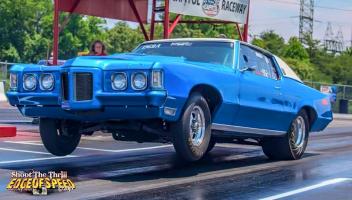
69 Grand Prix/3163lbs / IAII 535 w/ Tiger heads by Gaydosh....9.35@ 144 so far.. through mufflers. 1.26 60'.
Going back to track with pump gas engine....
My 60 Ventura retired to street/strip duty..
|