Quote:
Originally Posted by Sirrotica

It has a 1/8 inch restrictor that feeds off any oil pressure port. The oil feeds through slowly so it gets filtered completely and just returns to the sump. Cleaning oil to this standard can only be done slowly and since the by pass system has no bearing on oil pressure to internally oiled engine parts it has no by pass valve to open under extreme conditions as the compromised full flow system must have.
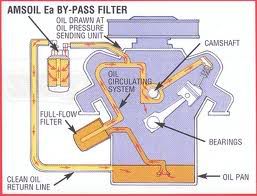
It is a closed system that takes a small portion from the oil system that would be by passed by the pump and does an excellent job filtering and returns it cleaned to the pan. It processes 4 quart in 5 minutes so in 6-7 minutes it will filter all the oil in the system once. Since the system uses oil that would normally be sent back to the pan by the oil pump by pass valve it has no effect on oil pressure. All oil systems have more than enough oil in reserve that bleeding of a minute amount for the by pass system has no ill effects.
Picture of by pass filter system:
 |
Hello Brad,
I have seen bypass systems used in the past but have a question about your wording above:
"It is a closed system that takes a small portion from the oil system that would be by passed by the pump and does an excellent job filtering and returns it cleaned to the pan."
ALL of the oil in the oil system goes thru the oil pump or it remains in the oil pan.
If the oil is never pumped by the oil pump it cannot reach the factory oil filter or the "by-pass system" which you describe.
1) Even the oil that gets by-passed by the "pump by-pass" built into the pump goes thru the oil pump gears first.
So if you are taking "pump by-pass" oil and filtering that oil and returning that oil to the pan, it is not going to happen with a normal Pontiac oil pump with an internal oil pump by-pass circuit. Now if you changed the words to by-passing the primary oil filter and routing some oil thru a secondary oil filter before returning that oil to the oil pan, that would be correct.
2) If you take oil thru a .125" orifice and then attempt to feed it thru a long line to a conventional passenger car turbo, you have the potential to starve the OEM Turbo of needed oil volume at high Turbo RPM conditions.
You might get away with that deal with a ceramic "ball bearing" style turbo (like the race guys use) because the ball bearing stuff can use a bit less oil vs a journal bearing Turbo but Turbochargers are expensive.
So at work we use an Oberg style 28 micron screen filter (designed for cleaning fuel) before the Turbo and catch a very large amount of "Stuff" before it gets to the turbo in a engine that has accumulated 1600 Hours of dyno time. So the 28 micron filter seems to be a more than adequate size as we have never had a failure of the engine or Turbo from starvation due to oil flow or metal contamination and yet have run the exact same turbo parts on at least 3 engines (each that accumulated over 1600 hours in dyno time).
You might say we are By-pass Cleaning that oil thru a 28 micron by-pass system as the oil goes thru the turbo and immediately returns to the oil pan.
So now I guess we can argue about what Micron size "By-pass" makes you happy.
Tom V.
ps The nice thing about the Oberg stuff is that you can remove the screen, wash it, and install exactly the same screen back into the system and never replace any "by-pass" filter period. Lifetime deal.