Quote:
Originally Posted by zippy

WOT itll starve for fuel after a second. Then kinda come back, If I ease off a little, she fine.
Also, If I slowly ease into her, she fine all way up to top speed, 6000RPM
|
FIRST, I would verify accelerator pump capacity. A weak pump might provide enough extra fuel for the initial jump, but not enough for the full transition to the main and auxiliary circuits. Not uncommon for the accelerator pump to deteriorate in modern fuel.
SECOND, I'd verify the air valve operation (spring, and vacuum break(s) as applicable) as other folks have stated.
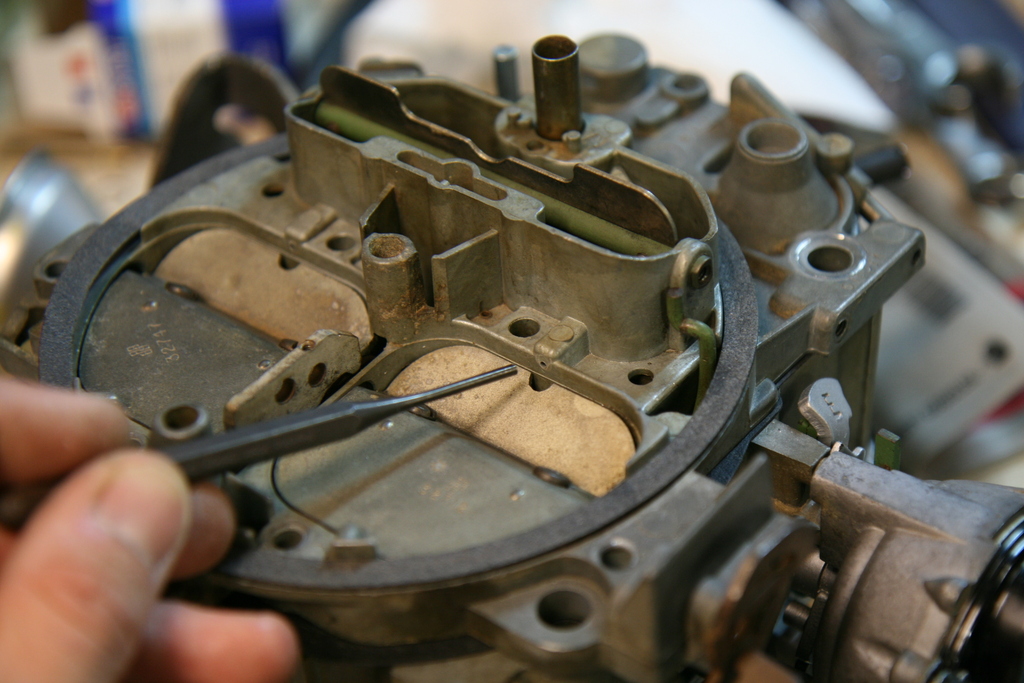
THIRD, I'd verify that the secondary "accelerator pump" drillings/tubes are functioning properly. As the air valve cracks open, it should draw fuel from the float bowl, up the tubes to the discharge ports on the casting beside the air-valve. I've seen Q-Jets where the tubes have fallen out of the air-horn casting, and
one where the float bowl had debris at the bottom, plugging one of the "wells" that the tubes sit in, so the well couldn't properly fill with fuel.
Photo (and it's not a great one) shamelessly stolen from The Internet.
Quote:
Originally Posted by zippy
I have Elec fuel pump, Holley Blue, and a .110" inlet seat.
|
If it runs good to 6000 RPM, the fuel pressure, inlet seat, and float-level are not the problem at throttle-stab.
Quote:
Originally Posted by zippy
Would you think its the small inlet seat not letting enough in when I really accel hard? Letting bowl drop and fuel slosh to uncover jets?
|
No. HOLLEYs "uncover the jets" on the secondary side, because they're facing the wrong way during acceration. Some Holleys on Fords are mounted BACKWARDS, so they uncover the primary-side jets for the same reason.
Q-Jets don't, because the jets are at the bottom of the float bowl, not angled 90 degrees from vertical.