


| FAQ |
| Members List |
| Social Groups |
| Calendar |
| Search |
| Today's Posts |
|
#11
 02-05-2010, 07:41 PM
|
||||
|
||||

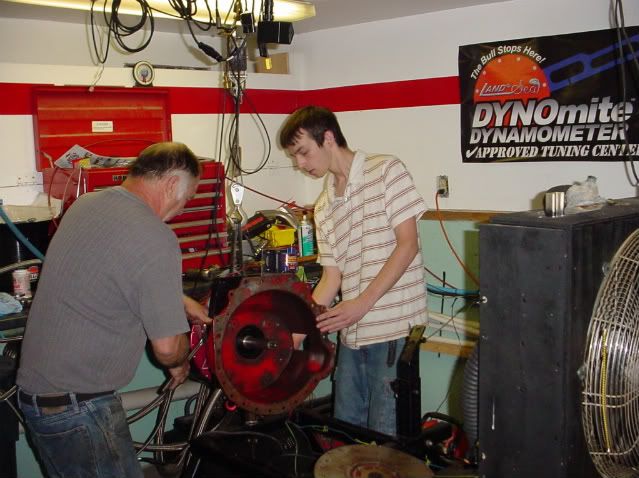 My machinist recommended that I work with Lenny Caverly to break in my new motor. Some of you may have heard of Len as a person who has competed nationally in engine building competitions. His specialty is Pontiacs, so he was the perfect person to help me bring the new motor to life. Best of all, he lives 30 minutes from my house. In this photo Lenny and his son are preparing the dyno to receive the motor. 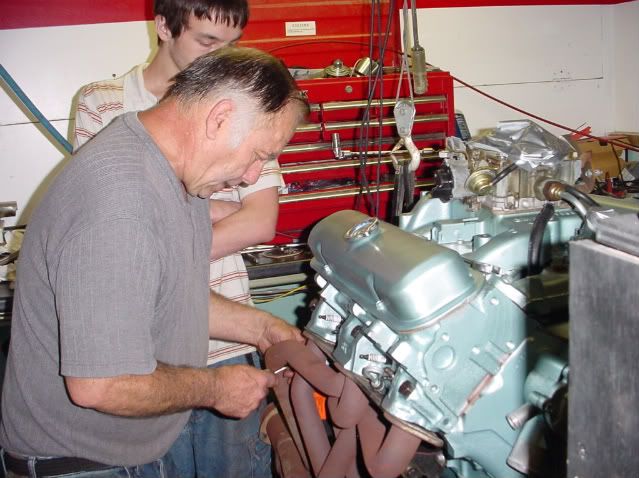 Here's the motor mounted on the dyno. Installing Pontiac headers is never easy, even when there’s lots of room. I mentioned earlier that I used the factory 068 cam for this rebuild. Melling still manufactures this original grind. Melling recommended the use of Rotella T for break-in oil, so that's what I used. I also added a small container of ZDDP just to make sure there was enough zinc phosphate present in the oil to protect the cam lobes and tappets during break-in. 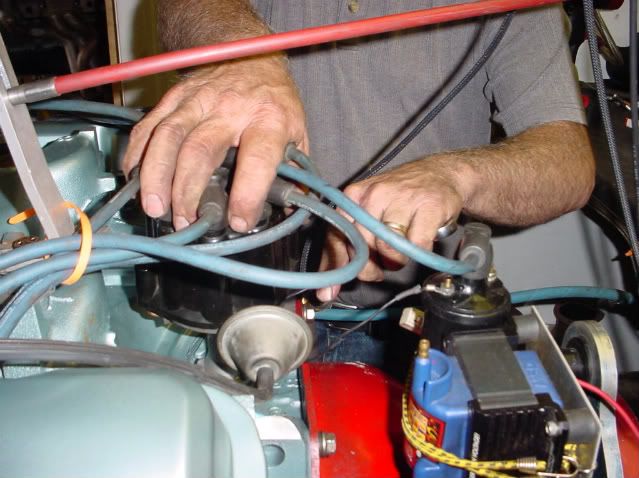 Proper ignition timing is absolutely critical to getting the motor to start on the first turn of the key. In this photo Lenny's double checking to make sure Karl and I had set the timing correctly. 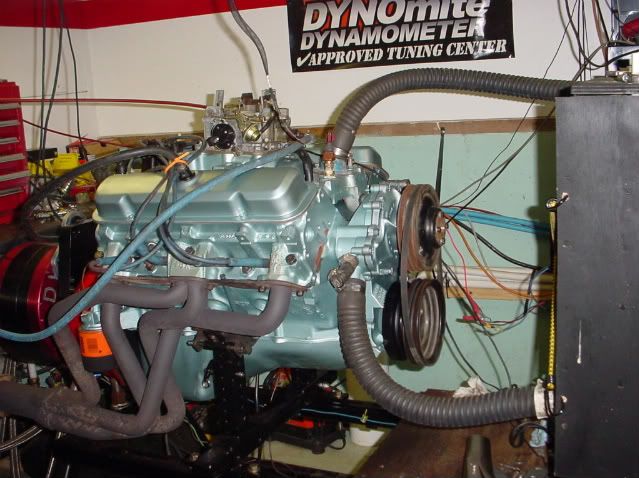 Here is the motor bolted to the dyno. The exhaust is hooked up, the gas supply is rigged, the wiring is complete, and Len installed a temporary belt to run the water pump. Everything had been checked and double checked, so this was the big moment. After 18 months of effort, would this motor run? Len hit the key, and the motor started right up. It was a pretty exciting moment. Hard to tell from the photo, but you can see the belt is in motion. An unbreakable rule for breaking in flat tappet cams - once started, the motor must stay over 2000 rpm for 20 minutes. The reason for the higher rpm is to ensure that enough oil splashes on the cam lobes during beak-in. If necessary, it is permissible to shut off and restart a motor during the break-in period. Just don’t let it idle. If I had retrofitted the motor with a roller cam, an extended break-in period wouldn’t have been necessary. Every motor breaks in a little bit different. This one wanted to slowly overheat. When the temperature approached two hundred degrees, Len would shut it down. In our case, we shut the motor down three times to allow it to cool off before hitting the 20 minute mark. One other small problem. There was a pretty good tap coming from under the driver's side valve cover near the number 5 and 7 cylinders. It wasn't bad enough to make us want to stop the break-in, but it was loud enough to let us know that something wasn’t right. 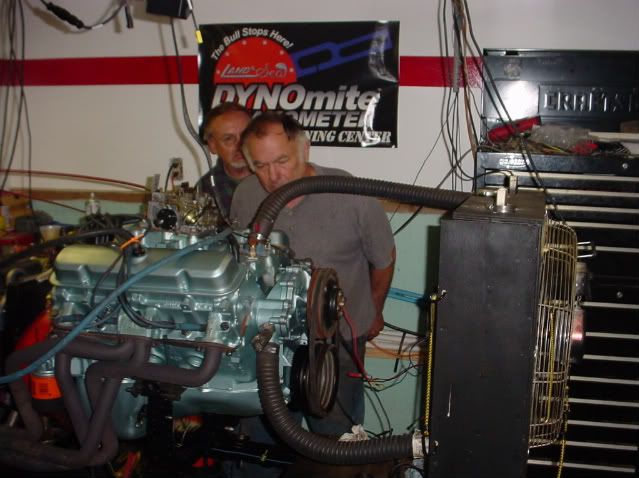 We hoped that the tapping would go away by itself early in the break-in, but it didn't. As you can see by this photo, we weren't too happy about what we were hearing. Len thought it sounded as though one of the valves didn’t have insufficient pre-load, so during one of the cool down periods we pulled the valve cover and checked. Sure enough, I had not put the proper pre-load on one of the exhaust valves. Once this was fixed, the motor sounded awesome. 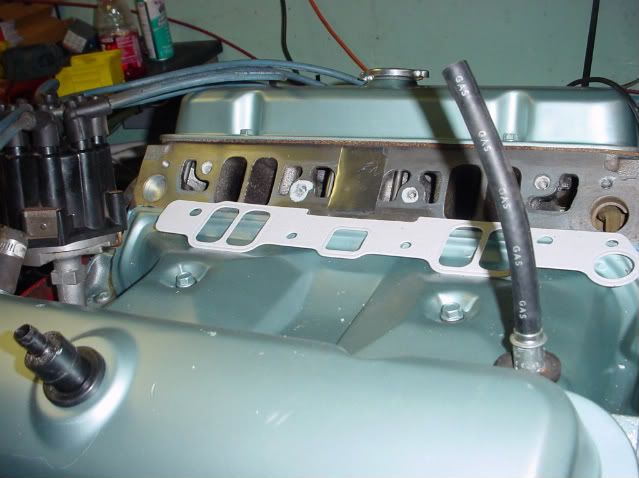 When Karl and I installed the shim on the exhaust port we used a piece of thin aluminum stock. Too thin, it turned out, so we needed to pull the intake and install a thicker stainless steel shim. 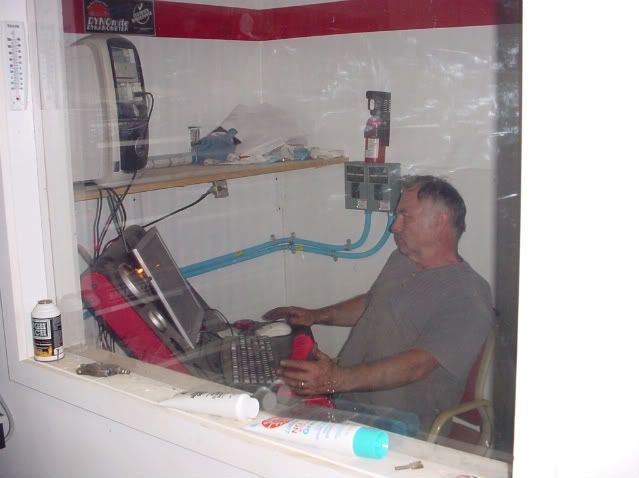 Once we had fixed the inevitable little problems. It was time to load the motor and try some preliminary pulls. 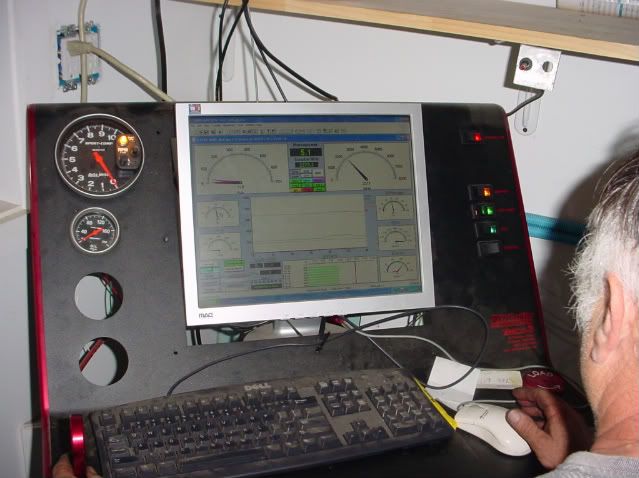 Here is a shot of the dyno screen. Don't look at the gauges on the left side. The digital display on the left allowed Len to track water temperature, oil pressure, air/fuel ratio, torque, and calculated horsepower. After several pulls, the water temperature stabilized at about 175 degrees. 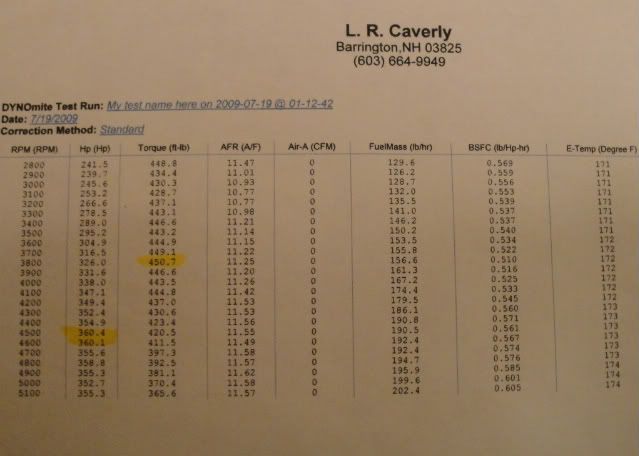 Here’s the results of one of the final dyno pulls. Max power (360) occurred at a street-friendly 4500 rpm and max torque (450) occurred at 3800 rpm. For a mild street motor the torque curve was respectable, with nearly 450 foot pounds by 2800rpm and staying over the 400 foot pound mark to 4600 rpm. You may notice that the motor was running lean on this pull. We wouldn’t have known about this lean condition had I just stuck the motor in the car. Although Len certainly had the skills and equipment to get every last bit of performance from this motor, I was satisfied with a mild tune and knowing that the motor would start and run uneventfully when installed in the car.
__________________
"Pay no attention to the planet Mopar. It is a strange and confusing place." ~Chiphead |
|
|
The PY Online Forums is the largest online gathering of Pontiac enthusiasts anywhere in the world. Founded in 1991, it was also the first online forum for people to gather and talk about their Pontiacs. Since then, it has become the mecca of Pontiac technical data and knowledge that no other place can surpass.




 Threaded Mode