


| FAQ |
| Members List |
| Social Groups |
| Calendar |
| Search |
| Today's Posts |
|
#21
 10-30-2004, 10:55 AM
|
||||
|
||||

Shaun, that's why solid ROLLERS are the ticket, not flat tappet solids! Talk about fast ramps!

__________________
Badder than old King Kong And meaner than a junkyard dog -Jim Croce |
|
#22
10-30-2004, 11:32 AM
|
||||
|
||||
|
Shaun, DiamondJim, I agree with you both in regards to solid cams, which brings to mind a story of my experience.
Until 1991, I ran hydraulic cams. The last one being a Crower w/320 degrees advertised and .510 gross lift. My '63 LeMans had run a best of 11.61 @ 120 with a 461" RAII headed engine. I had an old Isky roller and kit that had never been used, so when I pulled the engine to freshen, I put that cam in. It's specs were; 330 advertised with .540 lift (.510 net w/.030 lash). While degreeing the cam, I found the .050 to be 282 vs 254 for the Crower. I put the engine in my stock frame 64 GTO which weighed within 10 lbs of the 63. BINGO! 10.99 @ 122 the first time out. I've ran rollers ever since. No more hydraulic cams for me, not even if I build street Pontac. As far a valve adjustment goes. I think that I had to adjust two valves all summer.
__________________
Bill 64 GTO, tube chassis w/606" IA tall deck, PG & a pro geared Fab 9". 2750 lbs. [email protected]/4, [email protected]/8, 1.1981-60-ft. 8/10/08 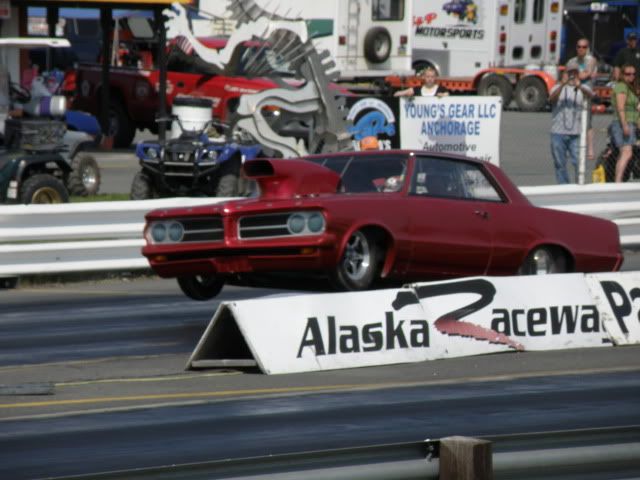
|
|
#23
10-30-2004, 01:11 PM
|
||||
|
||||
|
<BLOCKQUOTE class="ip-ubbcode-quote"><font size="-1">quote:</font><HR>Originally posted by DiamondJim:
Shaun, I guess the reason cams are compared at 50 is that is all we are given. I can remember when all you got was total duration. I agree with you on solid cams. I also agree that it is hard to compare a solid to a hyd, I have always heard subtract 7-8 degrees from the solid. I have run solids for years with very few problems. I have a custom Lunati solid that I am using now. It has asymmetrical lobes (Ultradyne) that are pretty aggressive. -Jim <HR></BLOCKQUOTE> |
|
#24
10-30-2004, 01:28 PM
|
||||
|
||||
|
So, you made a decision, huh?
__________________
Badder than old King Kong And meaner than a junkyard dog -Jim Croce |
|
#25
10-30-2004, 03:21 PM
|
||||
|
||||
|
Yea Dog, I have a new cam but I aint telling
 , nothing special. Couldn't afford too many upgrades so had to get one that would work with the heads/springs I have now. When my ship comes in I will swap heads and put in a roller like my rich friends! J/K -Jim , nothing special. Couldn't afford too many upgrades so had to get one that would work with the heads/springs I have now. When my ship comes in I will swap heads and put in a roller like my rich friends! J/K -Jim
|
|
#26
10-31-2004, 06:15 AM
|
|||
|
|||
|
I think you have to be very careful with cams & not have a 'one size fits all' approach. Plus, there are deep seated convictions that are more fiction than fact. An example would be as someone prieviously said, that an earlier cam opening event delays the power band. Well, if that is true, how is it, that in nearly every case, advancing a cam [ causing an earlier opening ], improves low end, because it makes power at a lower rpm?? Also, comparing hyd & solid flat tappet cams by using combinations of seat, 050 & 200 figures is risky, because valve lash MUST be subtracted from the solid to get a true comparison. Example with 1.5 rockers: a hyd cam @ 0.050" opens the valve 0.075". If the same profile used a solid lifter with 0.024" lash, the valve is only open 0.051", versus 0.075" for the hyd. In percentage terms, the hyd cam has 32% more opening at 0.050", a significant amount. This is why a hyd cam needs less duration than the solid for a comparable outcome, not to mention the lobe shape [ & the lash of the solid ]. The solid cam in my opinion has only two benefits, all else being equal: better idle because the valves seat quicker & possibly higher rpm because of no lifter pump up. Idle quality may not be a problem for some people, & stronger springs can move pump up away from the hyd cams's power band. My 02 worth.
|
|
#27
10-31-2004, 06:32 AM
|
||||
|
||||
|
Geoff, Inserting lash into the equation is the same as changing rocker ratios. Get what you want, with the rockers you want to use, ground into the cam(considering lash). I agree, it does make it harder to compare numbers. There was a reason the strongest traditional V-8's, 396/375, 427/435, 454/450, all used solids. -Jim
|
|
#28
10-31-2004, 08:23 AM
|
||||
|
||||
|
I can't help jumping in here. I have not the knowledge on this subject of many of you but I do understand why a solid cam will out perform a hydraulic. As stated above, GM and Ford, with all their engineering expertise knew back in the 60's, before the factory hydraulic rollers there was power in running solid cams. Their record is history, the Boss 302, LS6, the 350/350 Corvetts, the Corvetts Duntov cams, etc... The solid lifter flat tappet cam can safely run a more agressive lobe profile than the hydraulic counterpart. This faster ramp profile is where the power is, period. That's why the solid roller is king. The solid flat tappet is a less costly bridge between a hyd flat tappet and a solid roller, and is easier on valve train also.
Tim C
__________________
Tim Corcoran |
|
#29
10-31-2004, 08:42 AM
|
|||
|
|||
|
Actually, the solid roller doesn't really have much more peak rate then a flat tappet. It just holds the rate much longer. There is a gain to be had here if the roller has the lift, but the best bang for the buck is the solid flat tappet up grade from the Hyd. The gain is the biggest when switching from a hyd to a clearance ramp cam. The roller won't change the manners of the motor like response and power bands much over the solid, but the solid will drasticly change them as well as the motors acceleration rate as compared to the Hyd. Think about it: if a guy has an adjustable valve train, the solid cam and lifters are very close to the same cost as the Hyd cam and lifters, but to spring for the roller conversion, he is going to spend another grand by the time he buys lifters, an extra $100 or so for the cam, big Springs/Ret/Locks, etc. I consistently see small & big block chevy's and 5.0 Ford's with perf. hyd cams in street attire shave well over a full second off their 1/4 mile times at the strip by switching to a solid lifter cam and with no other changes to the car or motor whatsoever.
|
|
#30
10-31-2004, 08:50 AM
|
|||
|
|||
|
Geoff,
I used to work for UltraDyne. I now work with Lunati becuse that is where they all went, but I am staying where I am at. The reason you pick up when you advance the cam is that you pick up the cranking and cyl pressure because the greatest influence a cam has on cranking compression is the actual point of intake valve closing after BDC. Thanks. |
|
#31
11-02-2004, 05:27 AM
|
|||
|
|||
|
Cams are not a black & white issue. Hot Rod's Camshaft book is very enlightening on the subject & there is plenty of surprises. For one, it dispels the myth about tight LSA's being peaky. A couple of tests were done using identical cams, except for LSA. One pair was compared using 108 & 112 LSA. Another test also done using 110 & 114 LSA cams on 350 Chebby's [ what else!! ]. The results? " From the text: With the 108 deg cam, the engine produced 16f/p more torque & 5 more peak hp. But that only tells part of the story. From 2000 to 2750 rpm the 108 deg cam produced AT LEAST 30 f/p more torque at every data point; from 3000 to 4000 rpm, the average was 13 & 16 f/p." The test with the 110 & 114 LSA cams was similar; the 110 cam delivered more mid-range hp; the 114 cam delivered more top end hp, but the hp crossover point was not UNTIL 5250 rpm.
In another test in the book, three identical Isky cams, except for LSA, were tested. duration was 262/266 @ 050, solid lifter cams. The LSA's were 106, 108 & 110. The results? from the text: " The 106 LDA produced the most peak & average torque, as well as the most average hp & the highest cranking compression." For the 106,108, 110 cams these are some of the numbers: Peak tq: 504, 489, 479 peak hp: 580, 578, 583 Av thru 7000 rpm: hp: 525, 514, 506 tq: 476,463,452 There was also a test on advancing & retarding a cam 4 degrees. The cam was a Crane, 222/230 @ 050, 110 LSA. It was tested straight up [0], 4 deg adv & 4 ret. These are the results: 4 adv, 0, 4 ret: Av tq thru 4000: 379.4, 373.2, 369.0 Av 4200 plus: 369.4, 371.4, 371.4 Av overall: 374.4, 373.2, 369.0. test rpm range was from 2000 to 6,250 rpm. " |
|
#32
11-04-2004, 06:48 AM
|
|||
|
|||
|
Sounds Good.
|
| Reply |
| Thread Tools | |
| Display Modes | |
|
|
The PY Online Forums is the largest online gathering of Pontiac enthusiasts anywhere in the world. Founded in 1991, it was also the first online forum for people to gather and talk about their Pontiacs. Since then, it has become the mecca of Pontiac technical data and knowledge that no other place can surpass.




 Linear Mode

