


| FAQ |
| Members List |
| Social Groups |
| Calendar |
| Search |
| Today's Posts |
|
|
|
#1
 05-13-2025, 07:26 PM
|
|||
|
|||

Quote:
Secondary problems: 600 cfm DOUBLE BARREL Holley carb??? Apparently with no tuning Cam installed "dot-to-dot" when there's a half-dozen things that all are needed to be precisely machined for that to be accurate--and "accurate" may still not be "optimum". No mention of timing advance tuning No mention of piston design/quench distance/ring package/block honing As said--compression test needed. Fuel pressure test needed, with engine at WFO and max RPM. Verify throttle plates open fully, and the trans TV cable and shift-points match the torque curve. Last edited by Schurkey; 05-13-2025 at 07:32 PM. |
| The Following User Says Thank You to Schurkey For This Useful Post: | ||
|
#2
05-13-2025, 07:44 PM
|
|||
|
|||
|
Quote:
opps, I meant to type 600 cfm four barrel holley carb. It actually has a vac secondary. The other one I tried was a 750 double pumper but sold it since it was too much carb |
|
#3
05-16-2025, 06:06 PM
|
|||
|
|||
|
Quote:
Quote:
Driver side head # 1: 155 psi # 3: 160 psi # 5: 155 psi # 7: 158 psi Passenger side head # 2: 195 psi # 4: 194 psi # 5: 200 psi # 8: 187 psi I am ordering a leak down tester to see if there is leakage in that driver side head. Hopefully I should get that complete early next week. The next thing I realized, is the pushrods are indeed a little too short. See the test I did in the attached photos Passenger Side 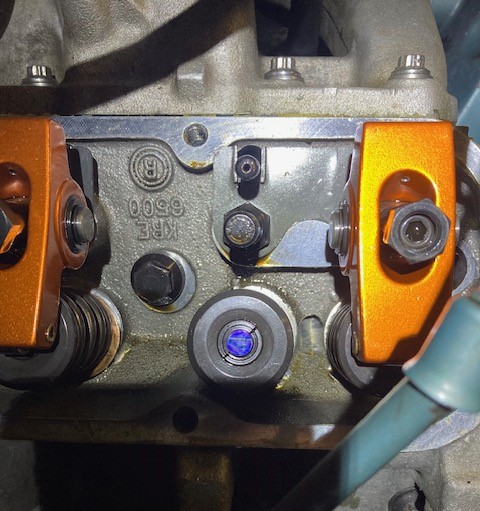 Driver Side 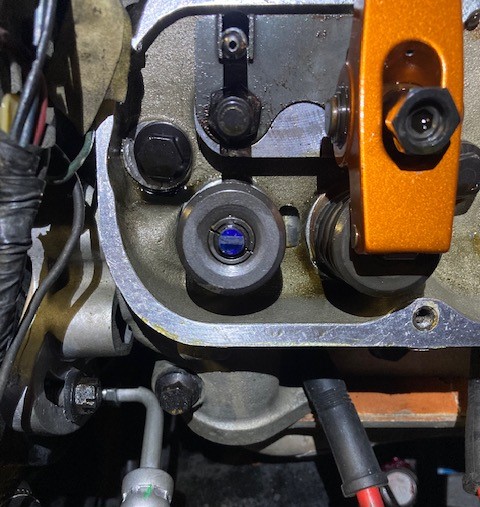
|
|
#4
05-16-2025, 07:56 PM
|
|||
|
|||
|
Quote:
There are no "industry standards" or legislation/regulation of automotive leakdown testers. They build whatever they want, and depending on how they're built, they can give WILDLY different results on the same cylinder. However, the FAA has standards for AIRCRAFT piston-engine leakdown testers, and the ones suitable for 5" bores and smaller aircraft engines are also suitable for automotive engines. Even better, Continental/Teledyne came up with the "Master Orifice", a calibrated leak that is the equivalent to the MAXIMUM leakage allowable in their engines. You'd plug a leakdown tester into a Master Orifice, note the reading. Then if the engine has less leakage than the Master Orifice, it's considered "good". My standards are higher than that, so I only allow about 2/3 the leakage of the C/T Master Orifice, and only then if it's past the rings--not past the valves, or into the cooling system. I bought an aircraft-spec leakdown tester with a built-in Master Orifice a dozen years ago. Very recommended. It normally ships with an 18mm cylinder adapter, they'll supply a 14mm automotive adapter on request...or buy several sizes and be able to do motorcycles and old Fords and Mopars. https://www.aircraft-tool.com/detail?id=2EM Quote:
|
| The Following User Says Thank You to Schurkey For This Useful Post: | ||
| Reply |
| Thread Tools | |
| Display Modes | |
|
|
The PY Online Forums is the largest online gathering of Pontiac enthusiasts anywhere in the world. Founded in 1991, it was also the first online forum for people to gather and talk about their Pontiacs. Since then, it has become the mecca of Pontiac technical data and knowledge that no other place can surpass.




 Hybrid Mode
