


| FAQ |
| Members List |
| Social Groups |
| Calendar |
| Search |
| Today's Posts |
|
#1
 04-24-2005, 07:14 PM
|
||||
|
||||

I'm considering converting the exhaust crossover on my Performer RPM intake to use hot coolant to heat the carb. The RPM intake is going on a 406-cube street engine with a Crower 60916 hydraulic cam.
The heads I'm using have no exhaust heat crossover (72cc E-heads) and I want to warm the intake for a faster engine warm-up on cold mornings (30 to 40 degrees in winter). I plan to weld an aluminum plate on either end of the intake crossover to cap it off, then tap 1/2 NPT into the top of the crossover passages on both sides. Coolant will travel from the rear of both heads to a tee fitting and then to the driver's side of the crossover. From there the the coolant will heat the intake/carb and exit the passenger side of the crossover and into the heater core. Even with no crossover heat (or no crossover at all) eventually the intake should end up the close to the same temperature as the coolant. I'm just hoping to heat the carb faster for smoother running and better economy during the first 10 minutes of running time. Am I on the right track? 
__________________
1964 Tempest Coupe LS3/4L70E/3.42 1964 Le Mans Convertible 421 HO/TH350/3.08 2002 WS6 Convertible LS1/4L60E/3.23 1966 VW Type 2 Single Cab Pickup 140hp 2276 1956 VW Type 2 Panel Van 36hp 1200 1957 VW Type 1 Beetle 180hp 2276 |
|
#2
04-24-2005, 07:20 PM
|
||||
|
||||
|
Would you be running a thermostat? If so wouldn't that cut off coolant flow until the engine is up to temp?
__________________
1966 GTO 1969 Lemans Convertible- F.A.S.T. legal family cruiser. 12.59 on G70-14 Polyglas tires. 1.78 60' 1969 Bonneville Safari- cross country family cruiser. . 1979 Trans Am 400, 4-speed, 4 wheel disc. View from the drivers seat racing down Atco Raceway- http://www.youtube.com/watch?v=GhYDMdOEC7A Ride along in the other lane-http://www.youtube.com/watch?v=mIzgpLtF_uw |
|
#3
04-24-2005, 07:22 PM
|
||||
|
||||
|
I don't think the water will get hot enough to help in 10 minutes.
I can see how it mind help overall.
__________________
John Wallace - johnta1 Pontiac Power RULES !!! www.wallaceracing.com Winner of Top Class at Pontiac Nationals, 2004 Cordova Winner of Quick 16 At Ames 2004 Pontiac Tripower Nats KRE's MR-1 - 1st 5 second Pontiac block ever! W.E.C moment "Every man has a right to his own opinion, but no man has a right to be wrong in his facts." "People demand freedom of speech to make up for the freedom of thought which they avoid." – Socrates |
|
#4
04-24-2005, 07:53 PM
|
|||
|
|||
|
It gets that cold in SoCal???
I think I agree with johnta1. Heat conduction into the manifold from the heads (even through the gaskets) probably heats the manifold up as fast as coolant would. I had rough running early Spring with the KRE heads (no crossover) but I also had pinging under acceleration and hesitation/snatch cruising in OD. I finally accepted that the q'jet was lean and went to 76 jets and 45 rods. It was a big improvement across the board, escecially the cold running. Probably didn't do anything for economy but just a suggestion. |
|
#5
04-24-2005, 08:42 PM
|
||||
|
||||
|
B-man,
I know a guy in FLA that did that on the CP board...his SN was Highflow and he liked how it worked.
__________________
Carburetor building & modification services Servicing the Pontiac community over 25 years |
|
#6
04-24-2005, 10:12 PM
|
||||
|
||||
|
By the time the water is hot, your engine will be. The exhaust gases are hot imediately so it warms the intake even when the engine is cold still. The water will take 10 minutes to warm as it gets the heat from the engine disipating it. I dont see any advantage in doing this.
|
|
#7
04-24-2005, 10:29 PM
|
||||
|
||||
|
I think Sixt8's right. The water will take to long to heat up. I have my exhaust crossover's filled with Alum and don't see any real problem. It's get's kinda cold here in Canada too. Mind you, I don't drive her in the winter, but what would be considered COLD in Cali is usually a ok day here LOL
__________________
Dan Pesonen  "If it ain't broke, modify somethin till it is" |
|
#8
04-25-2005, 01:09 AM
|
|||
|
|||
|
i think it is a good idea, alot of the old fords had water routed thru the carb spacer.
|
|
#9
04-25-2005, 05:09 AM
|
|||
|
|||
|
The advantage is to be able to put a control valve in the water line to shut it off for performance. Sounds like a great idea with blocked risers.
|
|
#10
04-25-2005, 05:13 AM
|
||||
|
||||
|
some late model 4.3 V6s were that way from GM that was with TBI, but still a wet manifold none the less
__________________
www.pro-touringf-body.com |
|
#11
04-25-2005, 06:32 AM
|
||||
|
||||
|
A little extreme but it would work with an inline electric tank heater preheating the coolant.
It was nice on cold North Dakota mornings to have a heater when starting the Jeep. Removing the battery every night and bringing it inside got old. Battery heaters didnt work too well at 30 below. 
__________________
""Guitar groups are on the way out", "The Beatles have no future in show business" Decca Records rejection of The Beatles - 1962" |
|
#12
04-25-2005, 08:11 AM
|
||||
|
||||
|
Running hot water through the carby base (as some Fords do, and some Kawasaki motorcycle engines as well) may have more to do with preventing carby icing in the venturies during normal operation than initial warm up of the intake mixture.
__________________
Regards, Leigh Pontiacs I’ve owned…. 1960 Laurentian 283 1963 Laurentian 283 1976 Trans Am 400 1977 Trans Am 400 1951 Chieftain Flat head 6 1967 Firebird 400 convertible 1967 Firebird 400 coupe 1979 Trans Am 403 1971 Formula 455 (clone) 1969 Firebird 350 1968 Firebird 428 manual. Sydney, Australia |
|
#13
04-25-2005, 01:10 PM
|
||||
|
||||
|
i have KAWASAKI ZX-10, and i have icing problem with my carbs on cold weather (even when engine is mid-heat) cause my carbs don't have heat system. icing come with too much air velocity on cold weather.
many old european carburetor cars have water coolant running tru carb/intake system. this system work fine. but i'm agree that exhaust gases can warm up faster the intake than water. |
|
#14
04-25-2005, 03:03 PM
|
|||
|
|||
|
Carb icing happens most often with ambient temperatures around 40 degrees F, and the venturi action along with fuel vaporization causes the throttles to become cold enough for humidity to freeze on them. Eventually you get enough frost to kill the engine at idle. If temperatures are much over 45 degrees, the throttle plates won't get cold enough to freeze the humidity. Much under 35 and there isn't enough humidity to freeze.
You need to keep the throttle body above 32 degrees F. At first blush, that's not all that warm, therefore it shouldn't be too difficult. Realistically, though, running coolant through the crossover passage is unlikely to do much for you because the heated coolant is so far from the throttle body. Now, if you were to build a carb spacer with a water jacket, that'd be a whole 'nother story. Pulling the manual choke halfway out until the engine warms up will assure that in addition to carb freezing, you'll also drool enough fuel down the manifold to wash the oil off the cylinders. Not the best plan. If this were me, I'd leave the manifold alone, and run a stock-type thermostatically-controlled air cleaner and heat stove on the exhaust, so you could pre-heat the AIR going into the carb, instead of heating the manifold or carb itself. And when you want performance, kill the vacuum to the air cleaner so it pulls in outside air. Problems solved, no plumbing nightmare, no welding, fewer hassles, and the manifold stays as cool as possible for best performance when you need it. |
|
#15
04-25-2005, 03:05 PM
|
||||
|
||||
|
Several Holley carbs (mostly Ricer type 2 bbls) used a water choke housing to SLOWLY cause the
choke to "come off" on cold starts. I looked at the same deal for a cross ram project. I thought the heat would be much better than a cold manifold on the initial first few minutes of running. You actually get heat into the heater pretty quickly when the thermostat is closed and the only water flow is through the heater core and back to the pump for another cycle. My deal was different though: I was going to use a oil cooler filer housing (like they use on trucks) that normally uses water to cool the oil. I was going to pump the water from the back of the heads, through the oil cooler, (cooling the oil, but also heating the water up very quickly), and then from the oil cooler going to the intake, and finally on to the water crosss-over. This way I would do two jobs vs just one. Once the intake was warm, I was going to use an old "pellet" vacuum switch off an Ford Escort to turn off the water to the intake and send it directly to the cross-over. If the intake cooled down too much the "pellet" vacuum switch would turn the system on again. All of the pieces could be hidden and no one would have been the wiser. Tom V. ps I don't have a heater in my car (heater delete) so the heater deal was out.
__________________
"Engineers do stuff for reasons" Tom Vaught Despite small distractions, there are those who will go Forward, Learning, Sharing Knowledge, Doing what they can to help others move forward. |
|
#16
04-25-2005, 06:35 PM
|
||||
|
||||
|
Thanks guys, I appreciate all of the replies.
 I'm still on the fence on this, however I will run a heat stove off of the drivers side head and hook it up to the stock '70 GTO twin-snorkel aircleaner that I'll be using. Yes, it does get a bit chilly (in So Cal anything below 50 is cold!) during the winter here in the high desert so I want to keep her running smooth during the morning commute. 
__________________
1964 Tempest Coupe LS3/4L70E/3.42 1964 Le Mans Convertible 421 HO/TH350/3.08 2002 WS6 Convertible LS1/4L60E/3.23 1966 VW Type 2 Single Cab Pickup 140hp 2276 1956 VW Type 2 Panel Van 36hp 1200 1957 VW Type 1 Beetle 180hp 2276 |
|
#17
06-14-2006, 01:45 AM
|
||||
|
||||
|
Here's a few shots of the exhaust crossover hot water plumbing. There is a 1/4" restrictor bushing in the elbow on the drivers side head and one in the tee on the passenger side head. Hot coolant will flow from both heads into the heater core, with the heated coolant flowing from the drivers side head through the exhaust crossover passage.
The brass pipe fitting assemblies will become more compact as they have not been tightened completely. The engine is not assembled yet, still in the mock-up stage checking for accessory fitment. An HEI distributor fits next to the plumbing with no clearance issues. 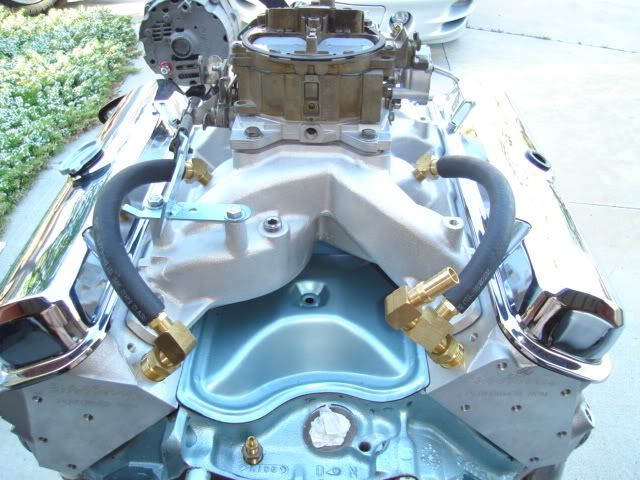 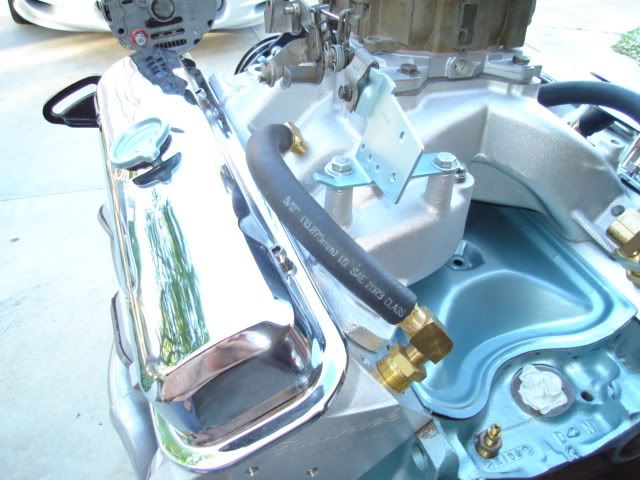 
__________________
1964 Tempest Coupe LS3/4L70E/3.42 1964 Le Mans Convertible 421 HO/TH350/3.08 2002 WS6 Convertible LS1/4L60E/3.23 1966 VW Type 2 Single Cab Pickup 140hp 2276 1956 VW Type 2 Panel Van 36hp 1200 1957 VW Type 1 Beetle 180hp 2276 |
|
#18
06-14-2006, 07:40 AM
|
||||
|
||||
|
b-man, that looks rather slick...your avatar is misleading.
|
|
#19
06-14-2006, 07:49 AM
|
||||
|
||||
|
With my Cliff Qjet or my TQ, I have no cold driveability issues on my 400 with the exhaust crossover removed.
__________________
 frittering and wasting the hours in an off hand way.... 1969 GTO, 455ci, 230/236 Pontiac Dude's "Butcher Special" Comp hyd roller cam with Crower HIPPO solid roller lifters, Q-jet, Edelbrock P4B-QJ, Doug's headers, ported 6X-8 (97cc) heads, TKO600, 3.73 geared Eaton Tru-Trac 8.5", hydroboost, rear disc brakes......and my greatest mechanical feat....a new heater core. 
|
|
#20
06-14-2006, 09:41 AM
|
||||
|
||||
|
B-MAN:
Do you think you could get some sort of Earls fittings instead of the brass? It would cost a bit more, but would look pretty sweet.
__________________
This world is your world, so take it, but take it easy. |
| Reply |
|
|
The PY Online Forums is the largest online gathering of Pontiac enthusiasts anywhere in the world. Founded in 1991, it was also the first online forum for people to gather and talk about their Pontiacs. Since then, it has become the mecca of Pontiac technical data and knowledge that no other place can surpass.






 Linear Mode

