


| FAQ |
| Members List |
| Social Groups |
| Calendar |
| Search |
| Today's Posts |
|
#1
 06-23-2012, 08:05 PM
|
||||
|
||||
 Bearing Question...
So, I bought this car that came with a 455 that hadn't run in over 10 years due to a "rod knock" that it supposedly had. I cranked it over by hand when the heads were on it and it had compression on all 8 cylinders. I pulled the heads off and it appears that it was recently rebuilt before it was parked as the cylinders were in great shape with no ridge. While cranking it with no heads on it, it turns nice and smooth, and when you rock it back and forth it makes zero noise like a bad rod, and when I wiggle any of the rods they are solid as a rock on the crank. So I tore the bottom end apart today and found that of all 8 cylinders, 1 (#8) has 1 pit on it near the oil hole and another (the #1) has a few more pits as evidenced in the photo:
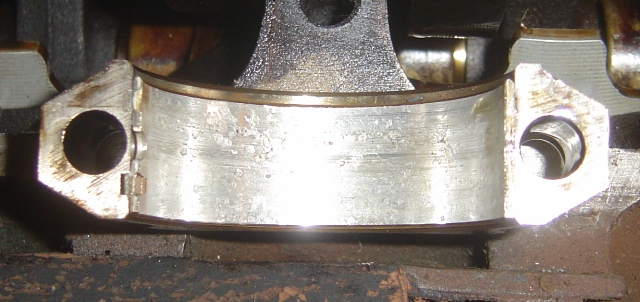 The crank is beautiful, no score marks or anything and it looks really clean and nice. The rest of the rods are all in great shape too and no marks or scoring, plenty of oil on them. So, question is, would this cause a "rod knock" that someone who knows nothing about cars might call it? Or would this not be an issue at all? I'm curious if this one just has a few pits due to sitting for so long. Could I just toss another set of bearings in it and put it back together? Obviously a full tear down and polish of the crank, etc would be in order but we're on a budget here and there's no point in doing work that doesn't need to be. The part number on the bearing is 11555 and nothing else, so I have no idea what size these bearings are. |
|
#2
06-23-2012, 10:43 PM
|
||||
|
||||
|
No. Yes. Yes.
|
|
#3
06-23-2012, 10:45 PM
|
||||
|
||||
|
Quote:
|
|
#4
06-24-2012, 02:07 AM
|
||||
|
||||
|
I'm wondering if there was coolant in the oil since that is about the only thing that will pit the Babbitt material that way. Do all the bearings look about the same? Were the head gaskets okay? Maybe spend a little time eyeballing the block over to see if any cylinder looks different than the others.
__________________
Mick Batson 1967 original owner Tyro Blue/black top 4-speed HO GTO with all the original parts stored safely away -- 1965 Catalina Safari Wagon. |
|
#5
06-24-2012, 11:50 AM
|
||||
|
||||
|
Quote:
|
|
#6
06-24-2012, 12:26 PM
|
|||
|
|||
|
Could be trash that came from the oil galleries. You said this looked like it was recently rebuilt. Had this happen to me when I did not clean the block properly after machining.
Mine looked worse than this and had to have my crank turned .010 .010 to clean up the damage.
__________________
1967 Firebird project in the works 400, 670 heads, 2802 cam, Hooker comp, Crosswind intake, Quadrajet, 700r4, 3.42 Posi. |
|
#7
06-24-2012, 12:33 PM
|
||||
|
||||
|
It is a gamble throwing bearings in it without having all components checked for proper specs, rods/pistons, crank, and block.
__________________
 1963 Cat SD Clone (old school) streeter 1964 GTO post coupe, tripower, 4speed (build) 1965 GTO 389 tripower, 4 speed, driver 1966 GTO dragcar 1966 GTO Tri power, 4speed, barn find 1966 GTO Ragtop 1969 GTO Judge RA lll, auto 1970 GP SSJ 1970 GTO barn find..TLB…390 horse?….yeh, 390 1973 Grand Safari wagon, 700hp stoplight sleeper 525ci DCI & 609ci LM V head builds Factory stock oval track car |
|
#8
06-24-2012, 01:11 PM
|
||||
|
||||
|
Quote:
|
|
#9
06-24-2012, 03:59 PM
|
||||
|
||||
|
I've had Stirtz Machine in Oakland do two of my Pontiac blocks....The one in my '67 was done in '88 and is still running great 77,000 miles and 24 years later. Not sure if they're still in business, but they did good work. I did my own assembly, and the machine work and specs were spot-on.
__________________
Jeff 
|
|
#10
06-24-2012, 04:20 PM
|
|||
|
|||
|
bearing question
You could spend $50 on a fair quality micrometer and check all the rod journals yourself and get an idea of what the condition is. Or get 2 micrometers and check all the crank sizes. Then you have tools and gain some experience too. Billk
|
|
#11
06-24-2012, 05:29 PM
|
|||
|
|||
|
Replace bearings and gouge on it!!!!
The bearings look to me as if they were subjected to water. The water droplets hit the hot crank and steam blasted the bearings. Saw this numerous times in diesel engines over the years. Do a bearing roll in and drive it. If problem persists then tear it down. I recently tore down a Case diesel engine that had spun a bearing. The tractor still had 25 lbs of oil pressure at an idle. The rod bearing was the thickness of bristle board paper and had ears on it like a main bearing. From the bearing spinning on the crank it was unbelievable how thin the bearing was. The crank looked to be scored but after cleaning with muriatic acid and 120 crocus paper much of the babbit and tin came off to reveal a somewhat uniform rod journal. Then after wrapping crank with 180 emery cloth and polishing with a rope, I then went to 240 and finished with 400. Each time dip the emery cloth in diesel as it will cut better. I used the bearing beside it with plastigage and found .002 oversize bearing would work. Put the engine back together and 40 lbs of oil pressure at an idle (warm). Tractor has been running strong for several weeks and no problems. Over the years I have heard that this is not the way a proper mechanic fixes engines. I beg to differ a real mechanic can do this and have success. When you turn the crank, I believe you are nothing more than a parts changer. From the turn of the 20th century to present how many engines got fixed this way. If an engine had to have the crank turned each and every time there wouldn't have been an engine in existance back in the 40's and 50's.
|
| Reply |
|
|
The PY Online Forums is the largest online gathering of Pontiac enthusiasts anywhere in the world. Founded in 1991, it was also the first online forum for people to gather and talk about their Pontiacs. Since then, it has become the mecca of Pontiac technical data and knowledge that no other place can surpass.




 Linear Mode

