


| FAQ |
| Members List |
| Social Groups |
| Calendar |
| Search |
| Today's Posts |
|
|
|
#1
 06-26-2019, 12:46 PM
|
||||
|
||||

Quote:
I asked dyno guy about this. The temp probe is temp in the dyno room. The engine pulls air from outside, through the air meter in the ceiling, not dyno room air.
__________________
Paul Carter Carter Cryogenics www.cartercryo.com 520-409-7236 Koerner Racing Engines You killed it, We build it! 520-294-5758 64 GTO, under re-construction, 412 CID, also under construction. 87 S-10 Pickup, 321,000 miles 99Monte Carlo, 293,000 miles 86 Bronco, 218,000 miles |
|
#3
06-24-2019, 02:32 PM
|
||||
|
||||
|
I imagine the Dyno computers are just windows computers with CMOS batteries (think the little disk batteries in your keyfob). If you have a power outage or pull the plug, it will reset the bios and the clock. There are plenty of little free programs out there to keep time, or even set windows to do it automatically.
Va68goat, when is the motor going back in? Have you worked out a date yet? |
|
#4
06-24-2019, 09:45 PM
|
||||
|
||||
|
Took me a while going back and forth but I see the second pull definitely made more power. The first pull had more peak torque. Should be a tire-fryer for sure!
It would be nice if they exported all the results to excel or comma separated values for you. That would make it much easier to compare. |
|
#5
06-25-2019, 12:00 AM
|
|||
|
|||
|
Dyno dyno dyno... yadda yadda yadda.
Get that thing to a track. That's the only dyno that means anything. If you never intend to race it, then who cares what that dyno sheet says? Get it tuned well and enjoy driving it. Dyno sheets are for bench racing.
__________________
---------------------------- '72 Formula 400 Lucerne Blue, Blue Deluxe interior - My first car! '73 Firebird 350/4-speed Black on Black, mix & match. |
|
#6
06-25-2019, 04:31 AM
|
||||
|
||||
|
Quote:
Get the motor in, running and just go enjoy it.
__________________
'71 Holden HQ Monaro - 3850lbs race weight, 400c/i - 11.4 @ 120 '66 Pontiac GTO - 389, 4 speed street cruiser |
|
#7
07-14-2019, 11:24 PM
|
||||
|
||||
|
August 5th 2018:
https://www.youtube.com/watch?v=LeOqYtY0Dng July 14th 2019: https://www.youtube.com/watch?v=To57VTU11xM |
|
#8
07-15-2019, 12:29 AM
|
||||
|
||||
|
That sounds like an exhaust leak. I like to use hi temp rtv with the gaskets. Hell... I've even had to weld extra flange material on headers to stop a leak. What gaskets are you using with those RA manifolds?
__________________
"...ridge reamer and ring compressor? Do they have tools like that?" |
|
#10
07-15-2019, 07:25 PM
|
|||
|
|||
|
My comment is directed to the engine noise in the car now. If the engine was run on a dyno 4 times and had no noise, but does have the noise when installed in the car, then the problem has to be something in the car or the way the engine is sitting in the chassis. Is everyone absolutely sure nothing is rubbing, vibrating, touching, sitting against, any other part of the body or chassis that can be transmitting normal engine vibration through the car and to your ear? I find it hard to believe that this engine would be such a world traveler, have been tested 4 times out of the car, only to have the same problem when installed in the car once again. What a puzzler.
|
|
#11
07-15-2019, 07:31 PM
|
||||
|
||||
|
Watching the video I would suggest the ignition system (distributor/spark) be gone over with a fine tooth comb. Make sure it's got good power!
A couple of observations, first when you try to start it you get that "cough" or minor backfire after a bit through the carb, that's a sign of spark firing too soon or when an intake valve is still potentially open. I doubt it was a side effect of heat/pre-ignition since you just started the motor for the first time. Also, if you watch the pattern of the motor misfiring after the belt squealing stops you can see it's a fairly regular "timed" shake to the motor. I've seen something similar when plug wires are out of order or a bad connection which could be causing the "knocking" you're hearing if the timing isn't right for a particular cylinder(s). Which is not good for the motor, so best to sort this out before continuing to run it. Also, that bolt that's been screwed in the middle of the carburetor where there would normally be the air cleaner attached. As your last post indicated, that hole goes all the way through the carb. That could be a vacuum leak if that bolt isn't "sealed" in there somehow. I don't know HWYSTR455 personally but he's had some pretty good advice on the forum here and hopefully can help you chase down the problem. I'm sure he'll check out ignition, vacuum leaks, etc. Hopefully he can help you find the cause! |
|
#12
06-26-2019, 12:03 AM
|
||||
|
||||
|
I will never race mine either but with Paul’s cam help, my expert local machinist, and butlers rotating assembly and ported round port heads I should have a hell of a machine. My machinist/engine assembler said looking at the parts and the cam specs 600 ft/lbs is not off the table
__________________
468/TKO600 Ford thru bolt equipped 64 Tempest Custom. Custom Nocturne Blue with black interior. |
|
#14
07-15-2019, 03:12 AM
|
||||
|
||||
|
Wow, Joe. So sorry to read about this after all you've been thru.
 I'll offer up my advice. Of course it's only that, my advice, so feel free to take it or leave it. But if I were in your shoes, this is how I would proceed... First off, Paul has been thru the motor twice, and has discovered nothing catastrophic going on inside. Those bases have been covered. Second, since the same sound was not heard 'consistently' when the engine was out of the car, but has been heard "rhythmically" both before and after only when the engine is in the car, it seems to indicate the noise may be related to another part of the drivetrain. I know you have been thru the flex plate/converter bolt scenario and there is nothing wrong there. So while the culprit is still at large, you have eliminated another potential drivetrain problem there too. At this point, knowing these things, I would absolutely drive the car. A lot in fact. I would take it somewhat easy in the beginning, monitor the vitals (water temp, oil psi), and as you go, listen each time for the sound after you drive. If in fact you do have a mechanical issue where metal to metal contact is occurring, it should lessen as you drive as the problem continues to 'self clearance.' If however that's not what is happening, and you do have a failure looming (like a bearing or what have you), the noise will likely get worse as you drive. So don't be afraid of it. Drive it. Just don't hammer on it too hard for a while until you decide if the noise is slowly going away, slowly getting louder, or simply staying the same. Based on those results, the diagnosis will likely get easier. The hardest problems to diagnose are always the "almost broken" problems. Hope that helps some, and like the others, I'll be waiting to hear how things progress. 
__________________
Eric Mitten '74 Bonneville 4dr Sedan (455/TH400/2.93 open) '72 LeMans GT (455/M-13/3.23 [8.5"] posi) '71 GTO Hardtop (400/TH400/3.07 12 bolt posi) ‘71 GTO Convertible (455HO/TH400/3.23 posi) '67 GTO Coupe (455/ST-10/2.93 posi) Deuteronomy 8:3 
|
|
#15
06-26-2019, 09:14 AM
|
||||
|
||||
|
For anyone who's interested, I made a spreadsheet where you can see the differences in the two pulls and where the increase was (pretty much from 3000-5200).
https://docs.google.com/spreadsheets...it?usp=sharing |
|
#16
07-15-2019, 04:40 AM
|
||||
|
||||
|
What ever it is it’s pretty pronounced, no clue what area it’s coming from??
|
|
#17
07-15-2019, 09:43 PM
|
|||
|
|||
|
I said this before, and say it again. You need to get your hand on that engine, before its idling for 10 minutes and too hot. FEEL for the noise. I cant believe you have a guy right there with all this Pontiac Experience and has no clue on where this noise is coming from. Get a wooden stick and put it to your ear and start poking around. After 10 minutes, you should at least have a good idea where it originates from, and go from there. Even make a slow motion video, with a timing light on the balancer, and see if its every revolution, or every other. Then home in on exactly where it is in the rotation of the crank. That thing sure shudders, I know that's not right, that should be smooth. Hard to imagine it could run so good on a Dyno, then get installed and turns to crap. Its going to be so simple, and embarrassing when we all find out what it is. I cant blame you for patience wearing thin, I would certainly be tearing my hair out by now. Did you crank it up with all belts off? Harmonic Balancer torqued down? front pulley bolts all tight? Fuel pump quiet? Feel the dipstick, all good there? Dist cap? Get your hand on things and feel for the noise.
__________________
1968 Firebird 400 RAII M21, 3.31 12 bolt, Mayfair Maize. 1977 Trans Am W72 400, TH350, 3.23 T Top Everyone you will ever meet knows something you don't. Bill Nye. |
|
#18
06-27-2019, 09:24 PM
|
||||
|
||||
|
Looking at the Dyno results, that looks like just where you want it to be!
Scott |
|
#19
06-30-2019, 08:06 PM
|
||||
|
||||
|
Va68goat ....how u makin out.....
__________________
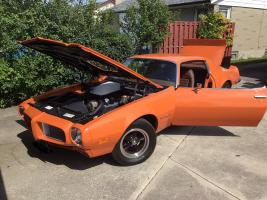 1973 Firebird Navajo Orange w/shaker,1973 400/461,1972 Intake SD CNC'd,1977 Q-Jet 800 CFM w/ Cliffs Kit,Tanks Inc PA4 255 Walbro intank pump ,-8an feed/return,RobbMc Regulator,RobbMc 40 micron filter,253 CFM 6x-8's w/H.S 1:5 Roller Rockers,SD Stump Puller H/R Cam 230/236 @.050 112 lobe separation 565/.570 lift,Crower Solid Rollers,28150 Hedman Headers,3" exhaust,full tailpipes,350 Turbo,9.5" 3200 Converter,3:42 gear,8.5 posi,C/E slide-alinks,Koni adj frt shocks,Best [email protected] Lookin for 11's 1973 Firebird Navajo Orange w/shaker,1973 400/461,1972 Intake SD CNC'd,1977 Q-Jet 800 CFM w/ Cliffs Kit,Tanks Inc PA4 255 Walbro intank pump ,-8an feed/return,RobbMc Regulator,RobbMc 40 micron filter,253 CFM 6x-8's w/H.S 1:5 Roller Rockers,SD Stump Puller H/R Cam 230/236 @.050 112 lobe separation 565/.570 lift,Crower Solid Rollers,28150 Hedman Headers,3" exhaust,full tailpipes,350 Turbo,9.5" 3200 Converter,3:42 gear,8.5 posi,C/E slide-alinks,Koni adj frt shocks,Best [email protected] Lookin for 11's
|
|
#20
07-15-2019, 11:16 AM
|
||||
|
||||
|
Formulajones,
I know you're a big fan of Paul and Jeff and you'll back them no matter what. I do the same for my friends. The motor blew up on the dyno because of a mistake with the pickup tube...that's a fact and a clue! Nobody did me any favors and I paid for everything. On top of the cost of the original build, I paid $1,900.00 in parts, fluids and tools to diagnose the motor (along with having the heads inspected). I was billed for sending the motor to Arizona and back. I was billed for the piston rings, bearings, polishing the crank and the light honing of the motor (I still don't have the receipts that I asked for). As for the carb...no. We worked out a deal when the windage tray had witness marks on it that I would pay $500 for a $1,400 Koerner carburetor. I was billed for that as well ($950.00 plus the $500 I sent them at the time) before they would release the motor. Before you co-sign for someone, you should know all the facts from both sides, not just what Paul or Jeff tell you. To get my motor back it cost me $2, 575 on top of the original build and on top of the $1,900 I had in parts. I wont applaud anyone for eating labor when it's the only right thing to do considering this experience. |
| Closed Thread |
|
|
The PY Online Forums is the largest online gathering of Pontiac enthusiasts anywhere in the world. Founded in 1991, it was also the first online forum for people to gather and talk about their Pontiacs. Since then, it has become the mecca of Pontiac technical data and knowledge that no other place can surpass.




 Hybrid Mode
