


| FAQ |
| Members List |
| Social Groups |
| Calendar |
| Search |
| Today's Posts |
|
#21
 06-14-2006, 04:45 PM
|
||||
|
||||

Quote:
I like the look of the OEM stuff, you can see how the rest of the engine is dressed in my post 'Another 400 engine'. http://forums.maxperformanceinc.com/...d.php?t=481776. I will be plumbing the fuel system using brass inverted flare fittings and steel hard line with an absolute minimum of rubber fuel hose, just like GM did it. 
__________________
1964 Tempest Coupe LS3/4L70E/3.42 1964 Le Mans Convertible 421 HO/TH350/3.08 2002 WS6 Convertible LS1/4L60E/3.23 1966 VW Type 2 Single Cab Pickup 140hp 2276 1956 VW Type 2 Panel Van 36hp 1200 1957 VW Type 1 Beetle 180hp 2276 |
|
#22
02-21-2015, 11:07 PM
|
||||
|
||||

Old thread from 2006 obviously.
I am in Michigan and the weather has been really cold this year (2015) Many days around 5 degrees F and lower in the mornings. Several day were -7 to -10 degrees F. I go to work early in the morning so I fire up the car and slowly drive the mile to the freeway. By the time I have gone that Mile (1/2 mile east and 1/2 mile south) I look at my water temp gage and it is almost at the mid point on the gage. (Fully warmed up temperature in the engine). Then I am on the freeway and up to normal cruising speed on the way to work. The point is, on my Ford Escape I can heat up the water in the coolant system to normal temp IN A MILE of slow driving. So I disagree with some of the old post that the water would not get hot enough quick enough. Tom V.
__________________
"Engineers do stuff for reasons" Tom Vaught Despite small distractions, there are those who will go Forward, Learning, Sharing Knowledge, Doing what they can to help others move forward. |
|
#23
02-21-2015, 11:32 PM
|
||||
|
||||
|
How did this work for you BMan?
__________________
Karl 
|
|
#24
02-21-2015, 11:35 PM
|
||||
|
||||
|
Sold the 400 engine - parted it out. Went a different direction with the car.
Never got to see how it all worked. Exhaust heat to the intake wouldn't have been an option, the 72cc E-heads have no exhaust heat passages to the intake.  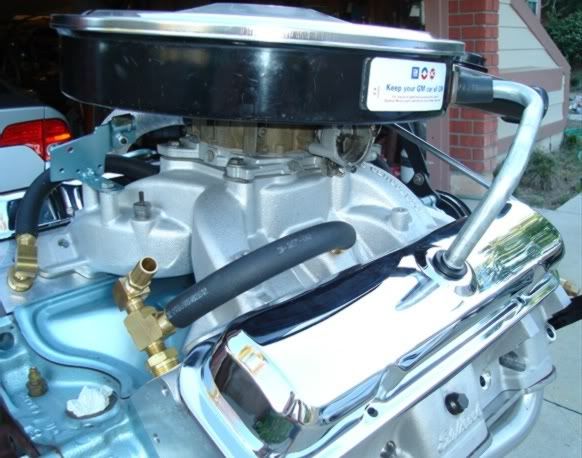
__________________
1964 Tempest Coupe LS3/4L70E/3.42 1964 Le Mans Convertible 421 HO/TH350/3.08 2002 WS6 Convertible LS1/4L60E/3.23 1966 VW Type 2 Single Cab Pickup 140hp 2276 1956 VW Type 2 Panel Van 36hp 1200 1957 VW Type 1 Beetle 180hp 2276 |
|
#25
02-22-2015, 10:46 AM
|
||||
|
||||
|
Quote from an carb website: "In David Vizard's latest book on Holley, he writes about a gas mileage test he did with a SBC. His conclusion was (paraphrased): the worst mileage came from an unheated or only heat soaked manifold, better was the exhaust heated (but robbed 10 to 12 hp), and best gas mileage was achieved with a coolant-heated intake that held the manifold temperature to between 180* and 190* at a cost of only about 5 hp. This was accomplished by blocking the ports of the crossover and plumbing coolant through it from the radiator."
So Vizard thinks that it works ok. TV
__________________
"Engineers do stuff for reasons" Tom Vaught Despite small distractions, there are those who will go Forward, Learning, Sharing Knowledge, Doing what they can to help others move forward. |
|
#26
02-22-2015, 01:11 PM
|
|||
|
|||
|
coolant to heat the carb does work, rather well actually. 80-81 turbo 301 t/a's used the coolant to warm the carb plenum, heats up to an effective temp in about 3 minutes. the turbo 301's design has an aluminum carb plenumn that is raised & not actually connected to the intake or heads like a traditional pontiac v-8. pontiac used a dual action t-stat that would allow flow to the plenum untill a certain temp, then cut it off & allow flow to the rest of the cooling system as normal.
as a performance mod, i tried blocking off the coolant flow to the carb plenum & in the summer it ran ok but i never noticed any real performance gain, but once fall set in or early spring, anything below about 55* & the engine would stumble & run very rich from fuel collecting at the bottom of the plenum. it would take almost 20 minutes for the plenum to even get warm. i hooked the coolant lines back up & within a few minutes the plenum was nice & hot & the car ran so much better on cold days & basically the same at operating temp. so GM knew coolant heating worked & as tom v said, the coolant does get hot enough to work & does it very fast. |
|
#27
02-22-2015, 02:19 PM
|
||||
|
||||
|
Quote:
What was the mileage gained with the heat?
__________________
Karl
|
|
#28
02-23-2015, 10:37 AM
|
|||
|
|||
|
Thanks for posting this B-man.
I would think the biggest downside would be removing the intake and having all the coolant go right down the cylinders? I would think the benefits would be getting the intake up to temp quicker and possibly a more even temps in the intake itself. |
|
#29
02-23-2015, 10:48 AM
|
||||
|
||||
|
Just had a thought as I looked at this thread again-
While I'm not too concerned with getting heat into the carb, would this actually help cool the carb in higher temperatures or heavy load? How hot does a cast iron intake get? It would seem that running coolant through it could actually draw out heat.
__________________
1966 GTO 1969 Lemans Convertible- F.A.S.T. legal family cruiser. 12.59 on G70-14 Polyglas tires. 1.78 60' 1969 Bonneville Safari- cross country family cruiser. . 1979 Trans Am 400, 4-speed, 4 wheel disc. View from the drivers seat racing down Atco Raceway- http://www.youtube.com/watch?v=GhYDMdOEC7A Ride along in the other lane-http://www.youtube.com/watch?v=mIzgpLtF_uw |
|
#30
02-23-2015, 11:40 AM
|
|||
|
|||
|
Coolant modifications
As I read this thread several things spring to mind. Vizard said the unheated intake was the one with the worst gas mileage while it appears it had the best HP gains. I wonder if in fact this might be due to the gas itself being cooler in the bowls. In the north the gas companies compensate for contraction under 10 or 15 Celsius. This was done in large part to them pumping more gas and getting paid for less because the atoms in the gas were packed tighter due to temperature. Now could there be a direct variation in the added power in the gas and the lower volume because of this. Ed
__________________

|
|
#31
02-23-2015, 11:53 AM
|
|||
|
|||
|
Coolant modifications
If I were using a performer intake with blocked exhaust ports and a carb with an electric choke to further modify the intake I would weld up the exhaust crossover ports in the intake. Then drill and weld (2) 5/8's bungs on either side of the crossover and install hose bibs in each. Run the heater return hose to one side and on the other run in back to the water crossover. Now to be really proactive in your search for the truth... install a hot water valve in the hose leading to the intake from the heater. The valve is activated with a push /pull cable. Install with cable pull under dash. Cruise with it open and close when you want that extra HP at the track or strip. Ed
__________________
|
|
#32
02-23-2015, 01:58 PM
|
||||
|
||||
|
Quote:
The heat cross-over normally has exhaust gasses passing from the heads to the open exhaust cross-over intake passage. No water there so far. If you decided to do the water method in the normal exhaust cross-over you would plug the intake manifold close to the intake gaskets and then add the water to the sealed chamber you have now created by the plugs. Again, no water can get to the cylinders. Hope this helps. The factory exhaust cross-over USED to have a butter fly valve that blocked exhaust on one manifold and forced it thru the exhaust cross-over to heat the car and then the exhaust went out one exhaust pipe. When the manifold wamed up the butterfly valve opened and let the exhaust go out both pipes, (Lower restriction vs the cross-over so the exhaust gas in the intake over time basically cooled off to engine temp). The proposal is to have the ability to add heated water to the intake if you drove the car in the early spring or late fall without cold drivability issues. In the summer the water could be drained or colder water right from the lower radiator hose plumbed into the manifold thereby keeping the intake closer to ambient air temp. Tom V.
__________________
"Engineers do stuff for reasons" Tom Vaught Despite small distractions, there are those who will go Forward, Learning, Sharing Knowledge, Doing what they can to help others move forward. |
|
#33
02-23-2015, 07:01 PM
|
||||
|
||||
|
I'm liking this idea as an option for my KRE heads which have no exhaust crossover! Could make quite a Spring/Fall improvement here in the Northeast.
__________________
 ___________________________________ ___________________________________ "Objects in mirror are closer than they appear" 
|
|
#34
02-23-2015, 07:47 PM
|
|||
|
|||
|
Just thinkin' out loud here......but you have pressurized coolant from both heads into the manifold. There wont be much coolant "flowing through" it. To make it work better it may have to come through the manifold and then into heater core inlet,correct? In other words keep the left side as it is, and then plumb from the right side of the manifold to the heater core inlet, and block off the right head heater passage.
|
|
#35
02-23-2015, 10:01 PM
|
||||
|
||||
|
Quote:
__________________
1964 Tempest Coupe LS3/4L70E/3.42 1964 Le Mans Convertible 421 HO/TH350/3.08 2002 WS6 Convertible LS1/4L60E/3.23 1966 VW Type 2 Single Cab Pickup 140hp 2276 1956 VW Type 2 Panel Van 36hp 1200 1957 VW Type 1 Beetle 180hp 2276 |
|
#36
02-23-2015, 10:28 PM
|
|||
|
|||
|
Juice aint worth the squeeze IMO!Tom
|
|
#37
02-24-2015, 10:33 AM
|
|||
|
|||
|
Quote:
Tom, I will be filling the heads with aluminum vs trying to block the intake. So in my case with the arched exhaust manifolds pulling the intake off would dump the coolant right out. I think I would have to use some Grey RTV and a some kink of block off plate at the ends. This was my thread on the same question. http://forums.maxperformanceinc.com/...d.php?t=769992 With the heads filled I see three option assuming I run an iron intake. 1. leave the crossover in place and not mess with it 2. do this mode similar to what B-man shows. 3. Cut the whole exhaust manifold off completely to lighten the intake and have better airflow around it. Most of my question revolves around if there is much of any benefit to this? My FB has just block off plats at the gasket and the intake still gets plenty hot but not boiling the gas out anymore. I would like to know if that David Vizard guy says if there is a sweet spot to for intake temps. I would also like to see what temps an intake runs with the exhaust cross over blocked. I need to purchase a IR temp gun. I'm familiar with that old butterfly valve. When I was a kid that was the first thing to go in my pursuit for speed. |
|
#38
02-24-2015, 11:02 AM
|
|||
|
|||
|
Quote:
|
|
#39
02-24-2015, 11:08 AM
|
|||
|
|||
|
Quote:
|
|
#40
02-24-2015, 11:31 AM
|
|||
|
|||
|
Crossover plumbing
The modified water crossover plumbing should be such that the one side is fed from the return from the heater core and the other side just returns to the water crossover up front. In essence you have put the new manifold water crossover in the path of the return from the heater core. Ed
__________________
|
| Reply |
|
|
The PY Online Forums is the largest online gathering of Pontiac enthusiasts anywhere in the world. Founded in 1991, it was also the first online forum for people to gather and talk about their Pontiacs. Since then, it has become the mecca of Pontiac technical data and knowledge that no other place can surpass.





 Linear Mode

