


| FAQ |
| Members List |
| Social Groups |
| Calendar |
| Search |
| Today's Posts |
|
#21
 01-18-2011, 11:58 AM
|
||||
|
||||

Which AFB are you running ... is it a vintage version? Carb seems very under-rated for a street build IMHO, having suffered old used Holleys for many years on my Fords.
|
|
#22
01-18-2011, 01:19 PM
|
||||
|
||||
|
Weber made, manual choke AFB Comp Series. No complaints so far, runs great. Builder took it out to test it after he put the motor in and couldn't believe it ran as good as it does. Says there's more than 325hp coming from it. I don't race it so that's not important. Just burning Regular gas and getting to where I want to go and back is all that matters to me.

__________________
 Gary Get in, ShuT Up, Hang On! Member of the Baltimore Built Brotherhood MY GTO built 4th Week of March 1966 "Crusin' Is Not A Crime" Keep yer stick on the ice. |
|
#23
07-30-2015, 12:13 AM
|
||||
|
||||
|
Old thread, new information
Quote:
Chamber ccs of the 9770716 421 HO heads before starting any work, with the original valves popped back in. The factory lists the spec for these chambers at 72ccs. Pretty close in size with only a .6cc volume variance, attesting to the excellent cylinder to cylinder compression ratio control provided by the fully machined chambers that were a quality feature built into all Pontiac V8s: 1. 74.2 3. 74.0 5. 73.8 7. 73.8 2. 74.0 4. 74.0 6. 73.6 8. 73.8  So rest assured both the 389 and 421 chamber sizes were identical. Heads that were factory spec'd as being 72ccs coming out to near 74ccs actual is to be expected, factory heads from no matter what year quite often measure larger than the factory numbers on chamber volume. The compression ratio difference was made up using much larger and deeper valve reliefs in the 421 pistons, much like the 428 used a 12cc dished piston compared to the 400 with 6cc valve reliefs. 421 piston is shown on the left and 389 on the right, both examples are 1964 factory original standard-bore pistons. I haven't measured both pistons, but it's pretty easy to see a considerable amount of added volume provided by the 421 pistons. The 421 pistons having 10ccs compared to the 389 pistons having 4ccs wouldn't be too far-feteched. 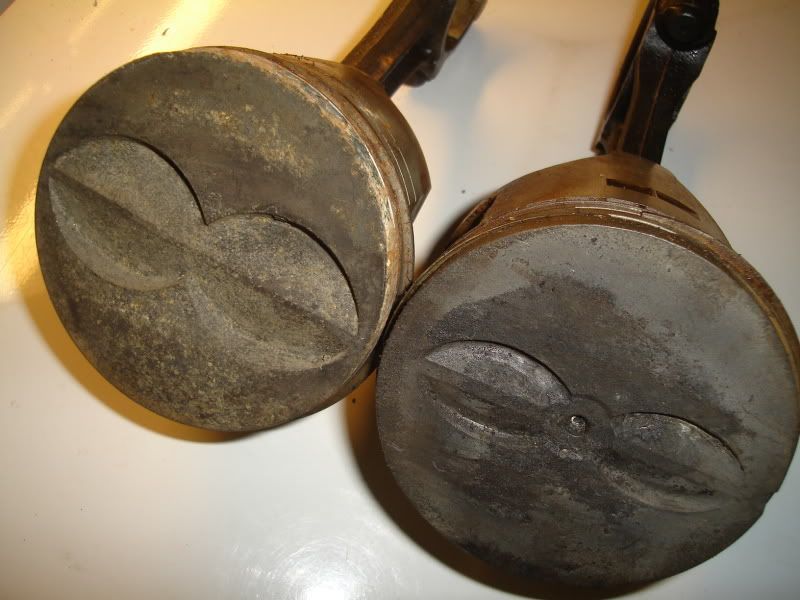
__________________
1964 Tempest Coupe LS3/4L70E/3.42 1964 Le Mans Convertible 421 HO/TH350/3.08 2002 WS6 Convertible LS1/4L60E/3.23 1966 VW Type 2 Single Cab Pickup 140hp 2276 1956 VW Type 2 Panel Van 36hp 1200 1957 VW Type 1 Beetle 180hp 2276 |
|
#24
07-30-2015, 08:57 AM
|
|||
|
|||
|
Nice b-man, Are you planning to reuse the pistons or?
__________________
If someone else can design it, I can sure figure out how to fix it. |
|
#25
07-30-2015, 08:44 PM
|
||||
|
||||
|
Quote:
In keeping with the theme of this thread here is the best way to set up your 389 or 421 to run on pump gas, a set of dished pistons. The one pictured below is for my 421, custom-ordered with a 26cc dish to drop compression all the way down to 9.05:1. 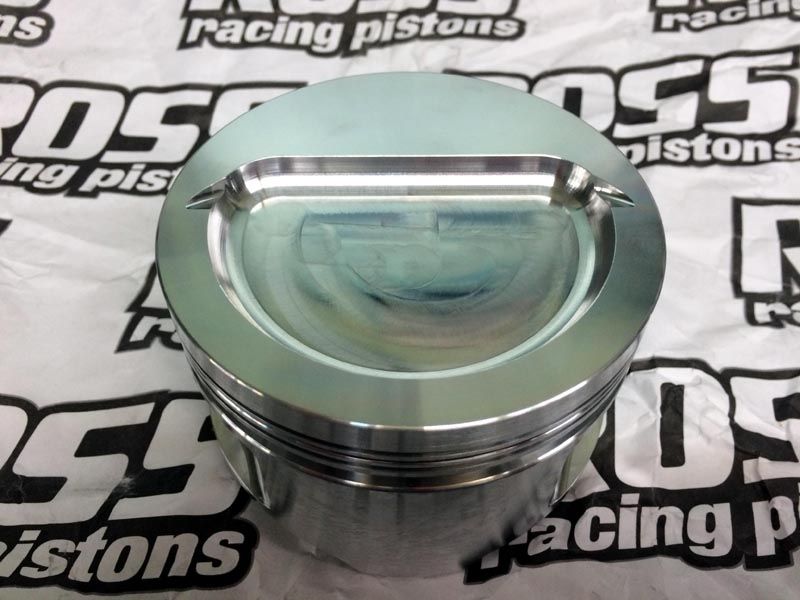 Another forged dished 421 piston, from RaceTec with a 23cc dish. The valve reliefs on this piston will allow the use of both early 20-degree valve angle 389/421 1966 and earlier heads (1.92"/1.66" valves) as well as 1967 and later 14-degree heads (2.11"/1.77" valves). 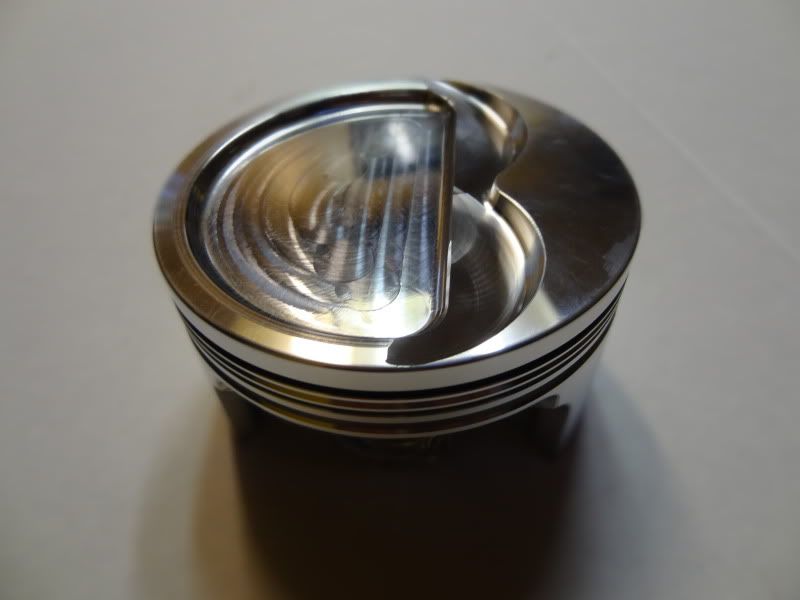
__________________
1964 Tempest Coupe LS3/4L70E/3.42 1964 Le Mans Convertible 421 HO/TH350/3.08 2002 WS6 Convertible LS1/4L60E/3.23 1966 VW Type 2 Single Cab Pickup 140hp 2276 1956 VW Type 2 Panel Van 36hp 1200 1957 VW Type 1 Beetle 180hp 2276 |
|
#26
07-30-2015, 09:09 PM
|
||||
|
||||
 Good info...
Quote:
__________________
"The great obstacle to discovery is not ignorance...but the illusion of knowledge." Daniel J. Boorstein "Gas is STILL your cheapest thrill!" Your opinion of me is none of my business. |
|
#27
07-30-2015, 10:06 PM
|
|||
|
|||
|
Guys, this thread is a little old now. My engine is finished. I D-dished my pistons similar to what you show. I had Butler's do it. They ran the engine in on the stand. I picked it up a year ago and am just now about to paint and detail it properly.
__________________
If someone else can design it, I can sure figure out how to fix it. |
|
#28
07-30-2015, 11:11 PM
|
||||
|
||||
|
Quote:
One of the biggest mistakes I see are folks in the old car hobby getting their older high-compression engines 'rebuilt' without any thought as to how they're going to manage today's poor-quality pump fuel. The high cost and difficulty of finding adequate high-octane fuel leaves many of these cars stranded in the garage and the owners disillusioned, losing interest because the car just isn't user-friendly anymore. Hopefully threads like this can help inform others about the best ways to get that engine into the proper shape for managing low-octane pump gas the first time around.
__________________
1964 Tempest Coupe LS3/4L70E/3.42 1964 Le Mans Convertible 421 HO/TH350/3.08 2002 WS6 Convertible LS1/4L60E/3.23 1966 VW Type 2 Single Cab Pickup 140hp 2276 1956 VW Type 2 Panel Van 36hp 1200 1957 VW Type 1 Beetle 180hp 2276 |
|
#29
07-31-2015, 12:27 PM
|
||||
|
||||
|
I went to 1966 heads 091's that yield 8.6 compression. Problem solved.From 1965 they are 75's and from 1964 they are 5437796. See Wallace racing cylinder head codes for others. Runs on regular and still has plenty of giddy up.
|
|
#30
07-31-2015, 09:23 PM
|
||||
|
||||
|
Quote:
True the '65 and '66 heads are all pretty much functionally identical with the exception of chamber ccs. The ports and valve sizes are all essentially the same. However in the case of 1964 heads using anything but the 9770716 GTO heads would be a definite downgrade, only the '716' heads have the bigger valves (1.92"/1.66" compared to 1.88"/1.60") and decent ports.
__________________
1964 Tempest Coupe LS3/4L70E/3.42 1964 Le Mans Convertible 421 HO/TH350/3.08 2002 WS6 Convertible LS1/4L60E/3.23 1966 VW Type 2 Single Cab Pickup 140hp 2276 1956 VW Type 2 Panel Van 36hp 1200 1957 VW Type 1 Beetle 180hp 2276 |
| Reply |
|
|
The PY Online Forums is the largest online gathering of Pontiac enthusiasts anywhere in the world. Founded in 1991, it was also the first online forum for people to gather and talk about their Pontiacs. Since then, it has become the mecca of Pontiac technical data and knowledge that no other place can surpass.








 Linear Mode

