| FAQ |
| Members List |
| Social Groups |
| Calendar |
| Search |
| Today's Posts |
 |
|


Menu
| The Body Shop TECH General questions that don't fit in any other forum |


| Reply |
|
|
Thread Tools | Display Modes |
|
|
| The Body Shop TECH General questions that don't fit in any other forum |
| Reply |
|
|
Thread Tools | Display Modes |
|
#1
 10-16-2009, 07:13 PM
|
||||
|
||||
 removing lacquer
I painted my car with nitro lacquer about 5 years ago.It has not held up at all.I'm thinking of stripping it off but only to the primer.Since there is plastic filler in quite a few places I don't want to use anything that will affect it.Any suggestions of how to remove about 5 coats?It does scrape off fairly easy with a putty knife,but looking for other ways.
|
|
#2
10-16-2009, 07:37 PM
|
||||
|
||||
|
In the "old days" I used Zip Strip chemical paint remover to get the upper layers of paint off used a plastic putty knike, followed by 400 steel wool dipped in lacquer thinner to get down to the primer and body filler. Might not be politically correct today, but didn't bother me so far.........
|
|
#3
10-16-2009, 08:43 PM
|
|||
|
|||
|
Since lacquers dry strictly by evaporation,not oxidation,you should be able to remove with lacquer thinner and rags.However,66post's idea to use stripper on the top layers might be considerably faster.
|
|
#4
10-17-2009, 12:56 PM
|
|||
|
|||
|
Don't know for certain but you may want to check and see if you can "seal" the lacquer and paint over it. (assuming it is in good condition) Although I've painted quite a few cars, I've always stripped them down to metal. Perhaps one of the paint experts will chime in on the pros and cons.
__________________
My money talks to me-it usually says goodbye! |
|
#5
10-17-2009, 02:32 PM
|
||||
|
||||
|
I used the cheap gun cleaning solvent to take the lacquer off.........Poured it on and sit a minute and squeegied it off....JB.
|
|
#6
10-17-2009, 04:57 PM
|
|||
|
|||
|
Quote:
As the above post,suggests,any cheap lacquer thinner,or gun cleaner,as long as is has ketone solvent(s)in it,will work.Look for MEK,MIBK,acetone,etc. |
|
#7
10-17-2009, 08:20 PM
|
||||
|
||||
|
No way I can paint over it,it has checking,blistering,cracking.Most of it has very tiny 'pimples' that make the paint look like the skin of a plucked chicken.A lot of the pimples are flaking off now but just to the primer.The paint looks worn and washed out and is easily stained and scratched.It also chips easily,I can take my finger nail and scrape the paint off.
|
|
#8
10-17-2009, 08:30 PM
|
|||
|
|||
|
If you primed with epoxy or any other type of 2k primer,you'll probably be okay stripping down to the primer.if you used lacquer primer,I'd take that off,too,as the same problems you are having with the lacquer topcoat will,sooner or later,develop with the primer.Sounds like the lacquer has already gotten "short"on you.On the possible bright side,it may sand off alot easier than you think.might be worth a try.good luck.
|
|
#9
10-18-2009, 11:29 AM
|
||||
|
||||
|
I didn't even know you could get nitrocellulose lacquer anymore.
I painted my car with acrylic lacquer in the early 90's. It never checked, but it wouldn't stay shiny anymore and I had buffed the paint really thin in a bunch of spots. I also used lacquer based surfacer-primer, which I also wanted to remove because of how much it shrinks. Everything was on top of dp40 epoxy primer. I tried wet sanding with 180 grit paper, but it was way too slow so I ended up using 80 grit on a DA until I could see the epoxy. I block sanded the rest off with finer grit, sealed with epoxy, and started over with catalyzed material. Most of the bodywork was salvaged, but it would have been about as easy to completely strip the whole thing. 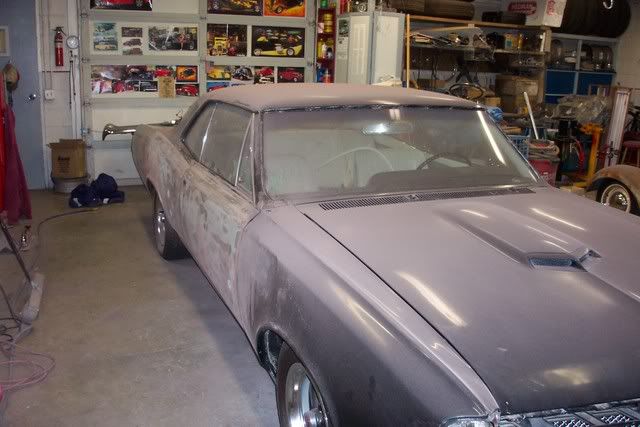 Don't use chemical stripper over plastic filler that you want to keep. You have no way of telling how far it soaked into it. The car turned out great, but it was alot more work than I figured. Dave |
|
#10
10-18-2009, 02:25 PM
|
|||
|
|||
|
Quote:
__________________
My money talks to me-it usually says goodbye! |
|
#11
10-18-2009, 08:10 PM
|
||||
|
||||
|
Quote:
That is accurate and extremely important. Anywhere that chemical stripper contacts needs to be taken down to bare steel, regardless of how many layers of material the stripper lifted. Doing anything less is risking completely re-doing it again. |
|
#12
10-19-2009, 06:27 AM
|
||||
|
||||
 Well, you probably won't believe this but a single edged razor is a great way to strip about 70% of it. In my experience, it will go exactly to the primer and filler and no deeper. The bonus is that you only have a lot of curled up strips of paint to dispose of instead of all that dust. It won't work on some oddly shaped or tightly curved surfaces but on the majority of the car....hood, trunk, roof, sides...it will work like a charm. Try it, you'll be surprised... Edit- Found this guy using a 4" wide blade. Even faster.. http://www.youtube.com/watch?v=dR9faQRZEqg
__________________
Greg Reid Palmetto, Georgia Last edited by Greg Reid; 10-19-2009 at 06:38 AM. |
|
#13
10-19-2009, 05:20 PM
|
||||
|
||||
|
I agree with Greg. I've stripped many a lacquer paints from cars with a razor blade - a bit slow, but will get the job done that you need to do with the least amount of mess. If anything, at least give it a try, if it doesn't work well for you,... move on to the next idea.
-r-
__________________
Never trust anything that bleeds for five days and won't die. |
|
#14
10-19-2009, 06:24 PM
|
|||
|
|||
|
if you use a chemical stripper it will attack the bondo.
Also stay away from cracks and seams,the stripper has a nasty habit of coming out later(usually when the nice paint job is done. Ditto on the razor blades,done many that way. Be careful not to gouge. |
|
#15
10-19-2009, 06:52 PM
|
||||
|
||||
|
I have done small sections with a razor before.Maybe I'll do it that way.
|
|
#16
10-20-2009, 12:52 AM
|
|||
|
|||
|
Just as a clarification on terminology(and in one of my above posts,I incorrectly used the word"stripping" when I should have used the word "removing")there is a difference between using a chemical paint stripper to attack and destroy a paint film,and using lacquer thinner to"wash off"old lacquer.All of the above posts that suggest using a stripper to remove lacquer(or paint of any type)will damage filler and leave a residue that might later migrate to the surface,causing future problems,are correct,based on my previous experience.This does not mean that you cannot use lacquer thinner to re-dissolve the old lacquer film and essentially wash it off,without attacking any 2-component materials underneath.This would include filler,which can be epoxy based,but is usually unsaturated polyester,either of which will have enough chemical resistance to lacquer thinner when properly catalyzed and sufficiently cured(as will epoxy and "2k" primer).However,as the above posts suggest,i would NOT use any type of "stripper" over filler for the above stated reasons.Avoid products that contain methylene chloride,dilimeolene,contain wax(to slow the evaporation rate)or say stripper on the label.If you decide to wash certain areas with lacquer thinner and hit a filled area,you may get some staining of the filler from the lacquer/solvent.Just make sure before you recoat it,you lightly sand and let it dry,the lacquer thinner WILL evaporate out of the filler if any is absorbed.If you use stripper,my suggestion(as others have said)would be to remove any filler that might absorb it.if you use lacquer thinner to remove the topcoat and it softens/lifts/wrinkles or attacks anything below,might as well keep washing,because that has to come off,too,for a sound substrate to apply a new paint to.good luck.
|
|
#17
10-20-2009, 09:27 AM
|
||||
|
||||
|
Quote:
|
| Reply |
|
|
The PY Online Forums is the largest online gathering of Pontiac enthusiasts anywhere in the world. Founded in 1991, it was also the first online forum for people to gather and talk about their Pontiacs. Since then, it has become the mecca of Pontiac technical data and knowledge that no other place can surpass.




 Linear Mode

