


| FAQ |
| Members List |
| Social Groups |
| Calendar |
| Search |
| Today's Posts |
|
#1
 09-28-2015, 12:03 PM
|
|||
|
|||
 brake bleeding questions
I have seen several master cylinders that have bleeder screws. I have always used the conventional way of bench bleeding, now I see that the auto parts store don't even provide the bleeder kits anymore.
How are you suppose to bleed the MC via the bleeder screws? I assume a person should still bench bleed the MC even if you using the one man suction method from a caliper or wheel cylinder? One last question. When I use the one man vacuum method to bleed the brakes I get a ton of micro bubbles that I assume is air coming from around the bleeder threads. Anyone else have that problem? |
|
#2
09-28-2015, 12:15 PM
|
|||
|
|||
|
you have to purchase MC bleeder kits now, most dont come with them
the tool i bought and used and LOVE is the Phoenix brake bleeder kit, it was a little costly, but man so versatile i plan to swap to a smaller bore MC next year, so i'll use that tool again to reverse bleed the system caution when you do that, the fluid could should out all over, at least the air bubble i had to get rid of caused it to go everywhere |
|
#3
09-28-2015, 12:28 PM
|
|||
|
|||
|
Wow that does look pretty cool. Do you reverse bleed with it or suction bleed as your personal preference?
https://www.youtube.com/watch?v=FB8kzUEqK3U I'm sure I would still spill brake fluid all over the place no mater what tool I used. |
|
#4
09-28-2015, 02:57 PM
|
|||
|
|||
|
for bench bleeding the master i have/use a pair of brake lines from a car/truck with teh right threads for the m/c. cut them with about 6" of line remaining & curve it up into the m/c. as you push the plunger on the bench the fluid goes back into the resevoir. if you want to use the fittings that are on some of teh older m/c's you just put a short piece of vac line on the fittings & direct them into the resevoir the same way. easiest, cheapest & best way i know of to bench bleed teh m/c.
|
|
#5
09-28-2015, 03:46 PM
|
|||
|
|||
|
Quote:
certainly helped for the issue i was having, couldn't get the air to purge normally not matter what i tried i also have the BluePoint/Snap-On air bleeder too, i mainly use that for sucking the masters when i replenish fluid on all of the cars, handy tool indeed (use it for brakes, power steering, etc) |
|
#6
09-28-2015, 08:15 PM
|
|||
|
|||
|
I would imagine that you wouldn't be fighting gravity with bubbles wanting to go up by reverse bleeding.
|
|
#7
09-28-2015, 08:58 PM
|
||||
|
||||
|
I've installed a lot of master cylinders,clutch and brake,production cars and assembling circle track cars.
I'd tell how I easily bleed them, but I know I'm going to take a beating from all over the place. No tools or special equipment/fittings required,no bench bleed, only the tools it took to remove the old one and an assistant for a few minutes. And if you ever saw or heard of someone getting shot in the face with the bench bleed kits they use to provide, you'd know some lawsuit eliminated including them. |
|
#8
09-28-2015, 09:50 PM
|
|||
|
|||
|
I work by myself almost all the time and do allot of brake work. What works well for me is to bench bleed the master cylinder with the kit provided. If no kit, I cover the ports with my fingers and slowly push the piston about 1/2 inch, The fluid will push my fingers off the ports, then I make sure my fingers seal the ports when I return the piston to rest. I do this 10-15 times and that is usually enough. Does make a bit of a mess, so have your towels ready. The kit deal is better. Once on the car, I use the vacuum bleeder in the order recommended for the particular system. Usually, for a front/rear split system it's, right rear, left rear, right front, left front. For most but not all diagonal split systems, it's right rear, left front, left rear, right front. As far as the little bubbles in the clear hose: Once you have had good flow from the calipers or wheel cylinders, take the vacuum bleeder off and just let it bleed with the bleeder open, gravity bleed. I usually count 50 drips into the pan at each wheel. Close the bleeders and your done. This works 90% of the time for me. Sometimes, you just have to have a helper work with you and manually bleed the system.
|
|
#9
09-28-2015, 10:18 PM
|
|||
|
|||
|
One thing I have found to be very handy since this has been the summer of brakes is to keep a spray bottle of soapy water close. I have yet been able to do any brakes without getting fluid everywhere.
|
|
#10
09-29-2015, 03:04 PM
|
||||
|
||||
|
Easy enough to make your own bench bleed kit from a few parts. Glass jar makes bubble observation simple and eliminates them getting sucked back into the cylinder. Far as bleeding the entire system goes, I am a fan of the Russell speed bleeders. Makes the operation a simple one man job.
|
|
#11
09-29-2015, 04:42 PM
|
|||
|
|||
|
Quote:
|
|
#12
09-30-2015, 02:25 PM
|
||||
|
||||
|
The fact that much greater volume of fluid is pushed out than drawn back in ensures the bubbles will be forced out eventually.
|
|
#13
09-30-2015, 11:32 PM
|
|||
|
|||
|
1. The problem with bench bleeding is that you put air back into the master cylinder when you connect the brake tubing during the installation onto the vehicle.
2. The problem with bleeding the master cylinder on-the-vehicle, is that many vehicles tilt the master cylinder "up" in front, which pretty-much guarantees two air bubbles in a dual-circuit master cylinder. Lifting the rear of the vehicle enough to level the master cylinder--tilted slightly "down" in front is better--will work wonders. Failing that, remove the master from the firewall or booster, DO NOT REMOVE THE BRAKE TUBES--just flex the tubes some as you pull the master cylinder forward off the studs, and down in front. Then "tickle" the piston with a screwdriver or wooden dowel as you watch the compensating port(s) in the reservoir. When the bubbles quit coming out the compensating ports, and you get geyser(s) from the port(s), you've successfully removed all the air from the master cylinder. 3. Reverse-injection bleeding MUST NOT BE DONE on ABS-equipped vehicles unless the brake fluid is CLEAN ALL THE WAY TO THE MASTER CYLINDER. Pushing contaminated fluid backwards through the ABS valving can land you a heap of problems. 4. Reverse-injection bleeding WILL leave an air bubble in each wheel cylinder/caliper that CANNOT be removed until you finish-bleed in the regular direction. In short, reverse-injection bleeding is only worthwhile when the system is completely empty, or virginally clean 'n' fresh, (i.e,. you've just flushed all the fluid in the normal direction before trying to reverse-bleed) and only then when you're willing to bleed in the normal direction afterwards. In other words, either you start with a clean and empty system, or you're bleeding in the regular direction to flush the contaminated fluid, bleeding reverse direction to justify buying the expensive tool, and then finish-bleeding regular direction again to burp the air bubble at the wheel cylinder that reverse bleeding leaves. I'm guessing they don't tell you that when you buy the expensive reverse-injection tool. 5. You can reverse-bleed any disc brake system simply, easily, and WITHOUT BUYING some crazy-expensive tool. Remove caliper, pump pedal to push the piston most (not ALL) the way out of the caliper. If the pads are worn, this is already done. Bleed the clean fluid in the normal direction until the caliper is full of clean fluid and the contaminated crap is in your drain pan...then close the bleeder screw, and push the caliper piston back into the caliper. When the piston is forced back into the caliper, all the fluid displaced will "reverse-bleed" right back into the reservoir. Done. Money in your pocket. Don't over-fill the reservoir when reverse-bleeding. 6. Buying a cheap "garden-sprayer" pressure bleeder is a great way to contaminate your new brake fluid. Motive Power and all the Communist knock-offs aren't doing any one any favors. None of the "garden-sprayer" bleeders have a diaphragm to seal moisture away from the brake fluid. 7. I own a vacuum bleeder as part of a Mityvac vacuum pump kit, and I've used it once in ten+ years. I HATE vacuum bleeding because it'll pull air forever around the threads of the bleeder screw. The most recent time I vacuum-bled, I was half-crazed with frustration. I was working on a Ford (ewwww...) and had the pressure bleeder adapter backwards on the master cylinder 'cause Ford masters are different from GM--and it was too late at night on a "charity" brake job. No amount of pressure would blow fluid through the lines because of my set-up screw-up. If I had been thinking straight, I'd still be 10+ years away from ever doing a vacuum bleed. 8. Any time I do minor work at the wheel cylinder(s), I gravity bleed. Simple, easy, effective, cheap. Requires nearly zero set-up time, and nearly zero take-down time. The actual bleeding can be slow, though. 9. Any time I do a brake fluid flush, major work, or work at/near the master cylinder, I pressure bleed using a REAL pressure bleeder having a rubber diaphragm to seal moisture/humidity away from the new brake fluid. Set-up and take-down time are considerable, but the actual bleeding goes really fast (Unless you're a dumbass like me, working on a Ford, and get the adapter installed backwards!) 10. Bleeder screws on the master cylinder? Yeah, I've seen photos. It's been so long since I've seen a master cylinder with bleeder screws in person that I can't remember it. I'd say a length of vacuum hose or clear plastic tubing from each bleeder screw back into the reservoir would do a great job of bleeding the master--IF (big IF) the front of the master cylinder is level or tipped DOWN when the piston is stroked. Last edited by Schurkey; 09-30-2015 at 11:50 PM. |
|
#14
10-01-2015, 08:04 AM
|
||||
|
||||
|
|
|
#15
10-01-2015, 08:35 AM
|
|||
|
|||
|
Pressure bleeding is the best method, I agree. But is out of reach for most of us working at home or in a small shop. At the school I worked at we had a fantastic pressure bleeder. Operated at 20--25 lbs., had dozens of adapters for every master cylinder you can imagine and cost over 5K to purchase. Held about 2 gallons of brake fluid so you had to use it often or the fluid would get stale just like in an old master cylinder. When all the other methods mentioned above failed, this machine would come to the rescue. Wonderful, but seldom needed.
|
|
#16
10-01-2015, 09:14 AM
|
||||
|
||||
|
I don't think so.
About $20 to build mine from scratch. Fresh fluid poured in master as you go round the car. |
|
#17
10-01-2015, 09:24 AM
|
|||
|
|||
|
Some nice write ups. Thank you.
Removing the MC from the Booster to get it level is a great idea if you have a pressure bleeder. That Phoenix brake bleeder kit sounds like the hot ticket but hard to justify almost $200 for a plastic hand pump and bunch of hose/fitting. I'm usually working alone in the garage too. I would prefer a pressure bleeder but the vacuum bleeding works OK. I'm wondering if I can put some grease on the bleeder screws to stop the micro bubbles that I get. I'm always amazed at the amount of air that comes out of a MC when bench bleeding. I really need to tear one apart and a booster too to see the inner workings. No better way to learn then that IMO. When I was getting new mufflers on I was asking one of the mechanics a bunch of brake questions. He told me the last car he had in had a spongy peddle that wouldn't go away. They have a 4 post lift and had the car on its nose to level out the Master cylinder before they got a couple of big bubbles out. They had an expensive bleeder system. |
|
#18
10-01-2015, 02:48 PM
|
||||||
|
||||||
|
Quote:
http://www.amazon.com/Branick-G300-P...essure+bleeder 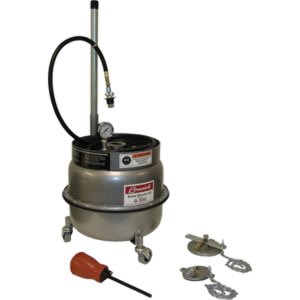 Quote:
Quote:
Quote:
Quote:
|
|
#19
10-01-2015, 04:18 PM
|
|||
|
|||
|
I guess I should have looked more. They have a entry level system for $60 and several others all the way up to a $760 unit.
|
|
#20
10-01-2015, 06:01 PM
|
|||
|
|||
|
The pressure bleeding unit that Schurkey posted is a great tool made by Branick. They make nice stuff like the best and safest strut compressors. If you are working with iron master cylinders. it's a great tool. The problem is nowdays, most are plastic and have 1 or 2 screw on caps. Many different sizes and screw threads. You really need a cover/adapter that specifically fits the master cylinder or ABS unit your working on. If you don't have a good fit you get a huge mess, brake fluid eating away at all the paint under the hood. Or worse, a leak that pisses brake fluid on the outer body paint. Ruins the clear coat or lacquer paint on contact. Those are the disadvantages of a pressure bleeder. It's all the custom adapters that add $$$ to the cost of the tool. Kind of like a radiator pressure tester. The basic tester cost $70.00. All the adapters to fit all the crazy radiator and pressure tanks out there, another $300.00.
|
| Reply |
|
|
The PY Online Forums is the largest online gathering of Pontiac enthusiasts anywhere in the world. Founded in 1991, it was also the first online forum for people to gather and talk about their Pontiacs. Since then, it has become the mecca of Pontiac technical data and knowledge that no other place can surpass.




 Linear Mode

