


| FAQ |
| Members List |
| Social Groups |
| Calendar |
| Search |
| Today's Posts |
|
|
|
#1
 01-06-2007, 10:47 AM
|
|||
|
|||
 WEAK CRANK WEBS ON 75 BLOCK
Have read about the 1975 and newer blocks being weaker than earlier ones.I have 2 blocks that need rebores,one is a 75 400 and the other is a 71 350.The 400 block is a 500557 casting and I am not sure which one to have the money spent on.I`m only looking to make around 350 flywheel horsepower,nothing special.Any advice would be helpful.
|
|
#2
01-06-2007, 10:52 AM
|
||||
|
||||
|
naw, no special bolt-ons.
Lighter slugs, Forged-rods, balance-to-remove excess crank weight. |
|
#3
01-06-2007, 11:14 AM
|
||||
|
||||
|
The 350's & 455's aren't a problem.
It's the late 75 to 79 400 blocks that have the issue. Do a search on here and you will see pics of the difference between the early and later 400 block. But 350 hp won't be a problem with the 557 block. I would make sure it has solid dowels in the mains and bottom fill it. Deburr any flashing or casting lines to remove stress risers. Keep the bore to .030 or .040 max. |
|
#4
01-06-2007, 01:55 PM
|
||||
|
||||
|
had a 76 T/A 400 557 block , stroked to 461 ,sonic tested ok , produces 355 RWHP for a hard driver and knock on wood
 official http://pontiacdragdays.com/Sponsors.htm dyno sponsor
__________________
 someone who thinks logically is a nice contrast to the real world. someone who thinks logically is a nice contrast to the real world.http://www.youtube.com/watch?v=3FfKVVZW1-Y |
|
#5
01-06-2007, 01:59 PM
|
||||
|
||||
|
I have one under some RAIV heads pushing around 400 hp and spinning 7000 before, so that level you will probably be OK. 12 teens @ 111 weighing 3900lbs.
|
|
#6
01-06-2007, 02:03 PM
|
||||
|
||||
|
Agree with the others, would'nt worry about it under 500hp.
__________________
If you cant drive from gas pump to gas pump across the map, its not a street car. http://s207.photobucket.com/albums/b...hop/?start=100 |
|
#7
01-06-2007, 03:03 PM
|
|||
|
|||
|
Thanks for replies.I think I may have been overly cautious.
|
|
#8
01-08-2007, 01:18 PM
|
||||
|
||||
|
#481988 = early '75 = thicker
#500557 = late '75 = thinner And I agree with the others. That #557 block will be fine in the stated HP range. As always, spend a little extra to have the block magnafluxed. If nothing else, for piece of mind.
__________________
1969 GTO hard top ~ Std bore 400, '70-RA3 block, 670 heads, Bal. & Blue... M22, 12-bolt w/3:55s |
|
#9
01-08-2007, 10:21 PM
|
|||
|
|||
|
Do you mean like THIS???
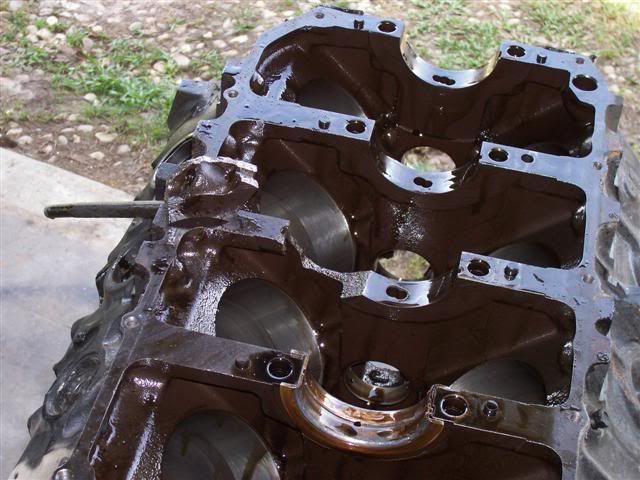 This was my old 500557 '75 400 block. It lived a good while in my daily driver 12.90 car. Then...one day it didn't... Be nice to your thin 400 and it will most likely live a long time. -Abone.
__________________
Daily Driver Model A Ford. 389 Pontiac w/6-71. 10.80 @129.5 1933, 1934, 1936 and 1940 Fords, also Pontiac powered. |
|
#10
01-08-2007, 11:01 PM
|
|||
|
|||
|
Here's the twin.
|
|
#11
01-09-2007, 01:06 AM
|
|||
|
|||
|
Hey Motor Daddy!!!! Click on this link for some fun and look at the CID on the .060" oversize 400!!!!!.....Robert
Bwwwwwwaaaaahahahahahahahahahahaha!!!! |
|
#12
01-09-2007, 01:26 AM
|
||||
|
||||
|
Ouch ...... double ouch!
 Those blocks are definitely thinner than the '75 cast #481988 block I have here. Pulled the block out of the bag (looking a little rusty) and snapped off a few images. Notice this particular block was cast late '74 but has the '75 casting mark. Most importantly, look at the same main web (#3) as shown above. Much thicker in the early '75 block. Straight up from main saddle to cam tunnel essentially.
__________________
1969 GTO hard top ~ Std bore 400, '70-RA3 block, 670 heads, Bal. & Blue... M22, 12-bolt w/3:55s |
|
#13
01-09-2007, 02:01 AM
|
||||
|
||||
|
Everything cast at some point just after 70 is softer also, I don't know where the exact line in the sand is but it is there.
|
|
#14
01-09-2007, 02:44 AM
|
||||
|
||||
|
Yes, popular thinking is that the '70 and earlier blocks were higher nickel content.
One thing is for certain, the older molds were put together differently. Results in stronger castings. For more info please see the last 3 posts in this thread. http://forums.maxperformanceinc.com/...d.php?t=490695
__________________
1969 GTO hard top ~ Std bore 400, '70-RA3 block, 670 heads, Bal. & Blue... M22, 12-bolt w/3:55s |
|
#15
01-09-2007, 08:31 AM
|
||||
|
||||
|
flamedabone, motor-daddy: those are important photos becasue they both show a 2-Bolt block with #3Bust-out....on right...across from the Motor-Mount that Is PULLING for it to bust.
As if you both had STEEL Caps....what kind of Main Caps&Fastners? |
|
#16
01-09-2007, 10:43 AM
|
|||
|
|||
|
Mine was bored +.030", but otherwise completely stock. The motor produced roughly 450 HP NA, and I also hit it with a 150 shot for almost 4 years, and went through probably 100+ bottle refills.
One day I went out to check the oil. I pulled the dipstick out, and heard the lower dipstick tube fall into the pan. Of course the dipstick couldn't be used after that because it would hit the crank. I pulled the motor and found my windage tray broke out three of the four mounting holes completely. The lower dipstick tube was broken off the bracket, and the bracket was broken at the main cap where it mounts. When I went to clean the pan, I found a dowel pin. I looked at the mains, and sure enough, #3 dowel was missing. I wondered at the time why the dowel pin would fall into the pan. I inspected it closely and found a crack about 1" starting at the dowel pin hole. I reinserted the dowel, slapped the motor together, and reinstalled it in the car. That was almost 2 years before that pic was taken when I finally removed the engine due to lower end noises (bad bearings). For those two years, I continued to beat the crap out of the motor with the cracked block, nitrous and all (600 HP) and it never completely died before I pulled it. I definitely wouldn't recommend a 500557 block for anything over 400 HP. Z Code, Two wrongs don't make a right. I already did the math for you. A 400 +.060" is not even a 412, although you can call it that if you round off. What it definitily is NOT is a 413! Just go ahead and finish that 417, 409, or 314! Which one do you prefer? That seems to be how you decide what to call it, personal preference. LOL |
|
#17
01-09-2007, 10:57 AM
|
||||
|
||||
|
Just KNEW splittin straight-up to the Cam bearing was not as-big-a-deal.
A telling summary of that block crack history...tink I heard it before. Do you suppose a Mid-Plate would have kept that block from cracking-out the #3?? -------------------------------------------------------------------------- motor-daddy: curious to your opinion of the PMD 350 CID nameplate? |
|
#18
01-09-2007, 11:04 AM
|
|||
|
|||
|
HIS, I really don't know squat about metal, but if I had to guess, I would say the dowel hole causes a weak spot in an area that is already weak. I don't think that crack would have ever resulted if there was no dowel hole there. Look how thin the metal is on each side of the dowel hole. It's a crack waiting to happen!
HIS, You don't want to get me started on my thoughts on CID! LOL |
|
#19
01-09-2007, 06:19 PM
|
|||
|
|||
|
Hey Motor-Daddy......Just giving you a bad time....Actually, I am planning on putting a roller in my .060" over 400 and putting the .466"/.466" - 220°/226° - 111.5° LSA hydraulic flat tappet in my 354......I mean 350....:-)
|
|
#20
01-09-2007, 07:23 PM
|
|||
|
|||
|
My 400 +.060" (411.68) runs [email protected] in a 3860 lb car on street tires with a Crower 60310, and a Torker II, and idles with 12" of vacuum at 900 RPM. Let me know what that roller runs when you get it done.
|
| Reply |
| Thread Tools | |
| Display Modes | |
|
|
The PY Online Forums is the largest online gathering of Pontiac enthusiasts anywhere in the world. Founded in 1991, it was also the first online forum for people to gather and talk about their Pontiacs. Since then, it has become the mecca of Pontiac technical data and knowledge that no other place can surpass.




 Hybrid Mode
