


| FAQ |
| Members List |
| Social Groups |
| Calendar |
| Search |
| Today's Posts |
|
#1
 07-06-2012, 09:44 PM
|
|||
|
|||
 389 vs 400 as basis for stroker build
Hi everyone,
I recently purchased my first Pontiac project (a '63 Tempest) and am trying to finalize the plans for the build of the drivetrain. I have a Ford 9'' with 3.89 gears that will find its way to the back of the car and am planning to go with a 4L80e in front of that. For the engine, my current thought is to build a stroked 3'' main motor (still considering 4'' v. 4.25'' stroke). My hope is to build a sleeper car that will be well into the 11s (or better?) in the quarter mile. I've been looking locally (southern Maine) and have found a couple of mid-60s 389 blocks and a couple of 400s, but all of the 400s I've located thus far are the later 70s 500557 blocks, which I have read are not the best option for a high performance build. I'm trying to figure out whether or not I should keep looking for a non-557 400 block, or whether I should just go ahead and pick up one of these 389s. Are there any significant differences between the 389 and 400 blocks that I may not know about (I've done a number of Chevys, but this is my first Pontiac build) that would be a big factor here? Is the ~.060'' bore difference a real potential limiting factor (for larger valves, etc)? Any and all thoughts are appreciated. Thanks guys. |
|
#2
07-06-2012, 10:09 PM
|
|||
|
|||
|
The 400 is a better bet, more parts support Hold out for the right one even if you gotta pay extra for a complete runner.
However.... If you wanted to fool the world you could get a 389 and period correct brackets/accessories and say its just a lil ol 326. What are you going to do about a drive shaft hump? A friend of mine built one and cut the entire hump floor section out of a vega and welded it right in to the floor of his 63. Took a week end to do it and it was done well so it looked totally stock. |
|
#3
07-07-2012, 12:32 AM
|
|||
|
|||
|
Since only REAL Pontiac guys would be the ONLY people that could tell the difference,
I'd use the 389. ALL Pontiac 3" main blocks are essentially the same except for cylinder bores. It is alleged the 400 has a bit more webbing in the valley, but I can't tell the difference between mine. Bruce Wilke is building a '59 389 based twin turbo engine and Steve Barack runs a '59 389 block in his dragster. If you concerned about block strength, buy a lifter valley brace kit. The '59-early '60 389 blocks don't need it (if you can find one).
__________________
“It takes considerable knowledge just to realize the extent of your own ignorance.” Dr. Thomas Sowell |
|
#4
07-07-2012, 10:14 AM
|
|||
|
|||
|
Thanks for the answers so far guys, any more are always appreciated.
In response to a couple of the questions/comments so far... I'm not concerned about being able to fool the keenest eye with regards to the sleeper look. I just want it to generally resemble to the casual observer what a factory car (or one that was hot-rodded a bit in the 60s) might have looked like at the time. So, for example, I won't be putting fuel injection in there, etc. Cool idea on the floor pan! I know I'm going to need to cut, but haven't yet put a lot of thought into how I'm going to "patch" that hole afterwards. I had just thought about bending some sheetmetal for it and covering it with carpet. The 389s I've found so far are mid-60s vintage. I've read that the early ones (pre '63?) may not have provision for a block mounted starter. Are those something I should avoid? |
|
#5
07-07-2012, 12:32 PM
|
||||
|
||||
|
Yes, a pre-'63 389 block will be a bit of a hassle, no starter mounting provisions and varying designs concerning block to transmission bolt patterns.
If you're up to making up adapter plates then the earlier blocks are an option, but most of us are looking for an easy bolt together conversion. My take: look for a '74 or earlier 400 block, they typically have a better amount of metal in the lower end of the block compared to a 389. If you use a 389 you should be okay if you aren't making more than about 500 HP, but look for a '64 -'66 block if you decide to use a 389 block. |
|
#6
07-07-2012, 09:16 PM
|
|||
|
|||
|
lthen your best bet is a 65 and later block and better stil is a 400/428/455 block, supposedly only GP and Tempest blocks had the starter mounted on the block, Cats and Bonnies were still tranny mounted(?). And of course you know to stay away from the later 400's although they can safely handle 450 HP acccording to some pulp lit.
period correct would mean offy dual quad, cast valve covers and the like |
|
#7
07-07-2012, 09:43 PM
|
||||
|
||||
|
Quote:
Bart, 64 is the better block, 65-66 have thinner castings and the cylinder walls are definitely thinner than 64. I had one 65 389 .060 over that the cylinder wall collapsed and the piston migrated into the water jacket making for a bunch of cast iron and aluminum shrapnel. Wondering what went wrong I did some investigating and found that Pontiac cut iron from the 389s starting in 1965 through 66. This was around 1971 before sonic testing was widely available for block thickness testing. Agree that 67-75 400 non 557 blocks are the best basis for the intended build. I've done the 63 Tempest conventional driveline swap and removing a transmission tunnel from a donor car is less labor intensive than trying to make one from sheetmetal. I used a 60 Ventura tunnel for mine. Sounds like a nice car you've thought out, good luck............... 
__________________
Brad Yost 1973 T/A (SOLD) 2005 GTO 1984 Grand Prix 100% Pontiacs in my driveway!!! What's in your driveway? If you don't take some of the RACETRACK home with you, Ya got cheated    
|
|
#8
07-07-2012, 10:20 PM
|
|||
|
|||
|
Quote:
Quote:
|
|
#9
07-07-2012, 11:07 PM
|
||||
|
||||
|
The few 66 389 blocks I have sonic checked all had thin walls, core shift and weaker lifter bosses. Best bet would be to look for a good 400 block.
__________________
There is no such thing as too much cam, just not enough engine. 1966 GTO - 11.31@119 (3478 lbs) in 1979 1967 Firebird - 9.73@138 (2940 lbs) in 1986 400 cu in / 295-298 cfm RAIV / Lunati Cam 278/283 - .704 lift/5.13 gears |
|
#10
07-07-2012, 11:52 PM
|
|||
|
|||
|
all 64 and newer blocks are drilled for block mounted starters.The changeover of a 61-63 tempest is not for the weak of wallet.There is tons of info on this site.The rear suspension is way harder and expensive than the trans tunnel.Do a lot of soul searching before taking on the project.FWIW,Tom
|
|
#11
07-08-2012, 12:55 AM
|
|||
|
|||
|
My son has two 64 389's both in Bonnevilles. Yes the starter bolts to the trans housing... however both blocks do have the pad drilled/tapped for conventional starter. The block mount starter and larger ring gear of the Superhydramatic dont work together.
Yes I'm building a 59 389... The bell pattern is unique to 55-60 Pontiacs. and no way to block mount a starter. 61 up uses the modern bell pattern but 61-63 still used a bell mount starter. I have the adapter drawings if you want to have one fabbed. There are adapters as well from Bendsteins and Wilcap. Kind of expensive. I have my labor(plenty) and about $20.00 invested in the one I made. Mine doesnt significantly change the transmission to trans mount distance. The others are rather thick and do affect the tail mount position. There are other differences related to early cranks, pilot holes etc., but a stroker fits just fine(minor block clearancing is common with all blocks using the stroker kits.) and the stroker kits use common flywheel register and clutch/convertor pilot holes. Block strength... the 59 and early 60 blocks are "king kong" ! Mine seems to have notably more nickel than my 69 400 block. Beefy bulkheads and reinforcement rib along the pan rail. Main caps are taller/thicker as well. Very thick bores... Pre sono I had another 59 that was at 4.21 bore! thats @.150" overbore from 389 bore size! (early forged "rubber" rods killed that one)Pontiac used this basic design for special blocks over the years. RAV and SD 455 have quite a bit of similarity and strength features these blocks have. Starting around 61(iirc) Pontiac (GM actually) changed over to thin wall casting techniques. This lightened the block some. The earlier ones still had reasonably thick cylinder walls. Early shop manuals allowed up to .090 overbore. 64 or 65 the shop manuals suggested .060 as max overbore. IMO they started using less iron. The 67 400 2 bolt is beefier than the 68 and up 2 or 4 bolt. Early 70's 400's are also pretty decent. Any of the blocks drilled for 4 bolt are a bit weaker than the ones drilled only for 2 bolt... the outer bolt hole is right in a thin section of the bulkhead. Basically all 400's will be up to what you have in mind with the exception being the 557 blocks. Whatever block your are looking at, pay attention to all the freeze plug casting holes... if some are significantly off center thats evidence there might be excess core shift. Find another if you see this. A sonic check is the only sure way though. Grandma type cars are more likely to have motors in better condition and less likely suffering affects of hard abuse. Dont be afraid to use a 389 either. Just be sure its sound and let the sono tell you how much bore you have. They are still far better than the 557 blocks. Just know that certain year 389's pose some challenges in mounting up the starter and possibly the transmission. My project is crawling along... may initially be NA as I'm getting sick of the SBC under the hood of my GP. Currently porting some 6x's rather radically and a not so radical set of 4x's. Have a set of TRW pop ups I could use with the 4x's for 9.5 comp NA use and a set of good rods is on my next to buy list. Might use my 400 block and save the 59 for my turbo build. Good luck on your build... you will find a good block eventually. Last edited by BruceWilkie; 07-08-2012 at 01:02 AM. |
|
#12
07-08-2012, 01:48 AM
|
||||
|
||||
|
The last '66 389 block we were going to drop a stroker kit came out of the car at .030" over. Did a sonic test and found out that the walls were already too thin at that current size.
I've noticed that the lifter bores are another place that will indicate core shift. If one side is thinner, you can pretty much figure that the cylinder walls are going to be the same.
__________________
Mick Batson 1967 original owner Tyro Blue/black top 4-speed HO GTO with all the original parts stored safely away -- 1965 Catalina Safari Wagon. |
|
#13
07-08-2012, 02:19 AM
|
||||
|
||||
|
The 400 block is stronger than the 389. Generally thicker casting and webbing. I know this because I have had both side by side on my bench numerous times.
__________________
1969 GTO hard top ~ Std bore 400, '70-RA3 block, 670 heads, Bal. & Blue... M22, 12-bolt w/3:55s |
|
#14
07-08-2012, 09:43 AM
|
||||
|
||||
|
Mick -- that is a super picture/diagram, makes me want to go out to the garage and start looking at all those old blocks!! thanks Lee
|
|
#15
07-08-2012, 01:54 PM
|
||||
|
||||
|
The block in the pic was the '66 389 block I mentioned before, and it was the original engine out of the friends '66 GTO. It had been cleaned and mag'd before the sonic test - and then sprayed with a metal preservative, so it was ready for storage. The friend took the block home and will store it for a possible full restoration on the car. A minimal cleanup hone and custom pistons will allow the engine to function for light cruising and driving to shows. Until then, we built out a fairly stout 455 for the car so he can romp on it and have fun.
I looked for the sonic sheet, but haven't found it yet. Several cylinders were sitting at a little less than .065" wall thickness in the thinner spots, and a couple were a little less than .080" on the thrust side at the current .030" over bore.
__________________
Mick Batson 1967 original owner Tyro Blue/black top 4-speed HO GTO with all the original parts stored safely away -- 1965 Catalina Safari Wagon. |
|
#16
07-08-2012, 03:04 PM
|
||||
|
||||
|
This is a 1964 GTO 389 block, it's amazing how much thinner the lifter bore castings are on the 389 in comparison to the same year 421 block.
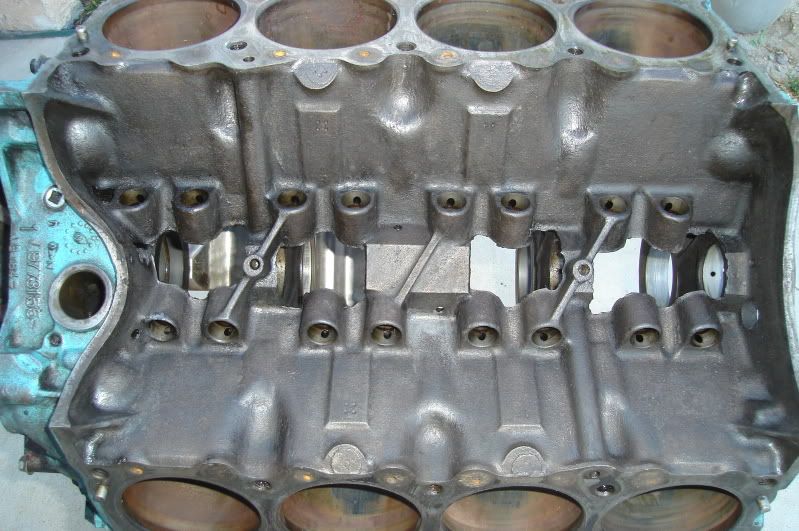 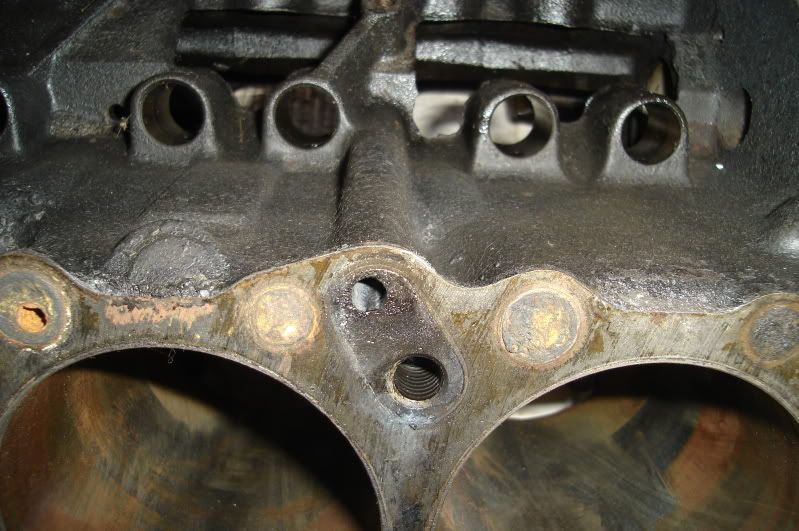   1964 421 HO block. The much thicker casting of the 421 block is evident just about everywhere you look. This block also accepts a block mounted starter.  
|
|
#17
07-08-2012, 03:21 PM
|
|||
|
|||
|
Quote:
Seems a trend that the 59 389, 67 400 were strongest of the lot... my old 68 350 was notably beefier than my 70 350 block. Early 455 seems a bit beefier than later 455's. Per previous post... pre-sono I had a 59 that was .150 overbore(4.21)... what I have now should go 4.25 bore. Deck is thicker than 400 plus reinforcement rib along pan rail. If I can find time today I'll take some pics of my 59 389 my 69 400 and a 72 455 block. Wish I could easily open the wifes 406... its a 557 block. About 8-9 years ago all 4, plus a 73 400 were all side by side. Should have taken pics back then. If I had all 5 to chose from now the strength order would be 59 389 2 bolt drilled, 73 400 2 bolt drilled, 69 400 2 bolt caps 4 bolt drilling, 72 455 2 bolt caps 4 bolt drilled, and the 76 400 2 bolt. A majority of the 68 and 69 400 blocks are all the same casting and most(all I've ever seen) were drilled for 4 bolt caps. Whether it had 2 or 4 bolt caps depended on application. The rare 69 and 70 RAV non production blocks were basically the 59 389 casting with revised bell and lifter bracing. The SD 455 was also a "special" casting with similar features. The special 389 (Harvey machine) Aluminum blocks were patterned same as the 59 block. Most 1960 blocks are about the same as the 59 but the deck drillings are different to accomodate the change from reverse cool to conventional cooling that year. 61 was the bell pattern change somewher in late 61 early 62 they changed to "thinwall" casting technique,and 64 added the modern starter pad though b body still used trans mount starter. |
|
#18
07-08-2012, 09:49 PM
|
|||
|
|||
|
This is great information guys! Thank you all for the responses, particularly pointing out what to look for regarding core shift. B-man: You're right, those differences in those blocks are like night and day.
tom s: Thank you for the warning. I'm planning on fabricating a Satchell link rear suspension for the car. I'm a bit rusty after a few years off, but I've built suspensions and frames before and feel pretty confident on that aspect of the build. If only I felt the same way about paint and body work! |
|
#19
07-08-2012, 09:50 PM
|
||||
|
||||
|
Quote:
GRX- making a statement like this- "The 400 block is stronger than the 389." is really inaccurate as there are many casting versions of each displacement. Certain 400s are indeed stronger than certain 389s but, some 389s are stronger, much stronger than any production 400 block. I learned this on my own about 20 years back quite by accident. Sadly, no known printed book or article has yet to recognize this. Not sure why the authors leave this important info out of their publications. The '59 and early '60 389 block is the strongest & toughest of all production blocks regardless of size or year. the only exception is the '58 370 is equal to the '59-"60. pontiac started taking weight out of the engine in 1961 and more out in 1964, It appears they put some back in for 1967. If you are looking to build something to last a long time or for a keeper, you would be wise to seek out an early block as a foundation. You may or may not need an adaptor depending on your trans choice. If you are building a manual trans, you can use a 58-60 bellhousing. This fits later 4-5-6 speed trans and uses a stock starter. If using an automatic, you will need an adaptor. With all the choices for blocks today, my preference for both my nitro burning AA/Fuel dragster and my 577" blown stroker is a '59 389 block. I have other engine designs using these early blocks as well. '59 was the first year using the modern side motor mounts and there is very little to adapt to fit late model/aftermarket parts after you take care of your bellhousing needs. Good luck to you whatever you choose. I would discourage using a '64-6 389 block.
__________________
Hundreds of Pontiacs in Az "Real Pontiacs only..no corporate nonsense!" Facebook- Pontiac Heaven Hosting- 23rd annual Pontiac Heaven weekend- Phoenix pending due to covid Pontiac Heaven Museum in process Phil 2:11 |
|
#20
07-08-2012, 11:35 PM
|
|||
|
|||
|
Well it's still hot in my garage... I need to clean up the 400 to get usable pictures... busy day tomorrow but it will be a lot cooler... we are finally getting some rain...(been several weeks and past 10 days temps have been 105-112 range) Maybe tomorrow nite or Tuesday on the pictures. Possibly video if I can figure how to post it.
I think its important to show this stuff... Like Steve I found out about the 59 by accident(post mortem inspection unfortunately...damn early forged rubber rods) about 12-13 yrs ago. Lots of diggin to find out alot of this stuff. Steve has been quite helpful and I cant thank him enough for the info he has shared. Old service manuals help... I do know the 64 manual limited max bore to +.060" and earlier manuals allowed +.090"... certainly a clue things werent as thick as prior years. Here is the 55-60 dowel locations and the adapter for 61-63 t400. I more or less married the two drawings and made additional measurements on the 59 block to make my t400 to 59 adapter.(I've been meaning to do a single drawing with all the dimensions and my notes... I'll post it if I ever get around to it.) I used a 58 starter instead of 61-64 starter so my bolt location is different. IMO a RobbMC mini for a Toronado or Eldorado would be a better choice and uses same pilot hole and has same pinion tooth size. (easier bolt up) Also a pic of my adapter... very functional at this stage but ugly.(Pretty happens after I fit it as a mid mount plate in my car. BTW the 55-60 block the bell mount face is recessed relative to the thrust bearing compared to later blocks... @ 1/4" just slightly less than the thickness of my adapter. At most I might need to shim my convertor 1/16" and its remotely possible I might need a change to my convertor pilot but mock up seems to be ok as is. Dialing in trans runout was tedious...setting starter to ring gear clearance is a must before welding the "pilot plate" in place. I used steel plate(3/16) so I could weld nuts where needed for the t400. (they just clear the block). Starter pad and plate area are 3/8" thick and the pinion clearance disengaged is good and when starter is engaged the pinion fully meshes without bottoming on the ring gear. Slightly worn ring gear and pinion I have clearance of .028" (near high side of spec... if both new it should fall to mid spec) The two upper holes in the trans had to be enlarged... the early block uses bigger bolts and the upper hole centerlines arent quite the same(close though) |
| Reply |
|
|
The PY Online Forums is the largest online gathering of Pontiac enthusiasts anywhere in the world. Founded in 1991, it was also the first online forum for people to gather and talk about their Pontiacs. Since then, it has become the mecca of Pontiac technical data and knowledge that no other place can surpass.







 Linear Mode

